The CFPB applied credit-card rules to buy now, pay later on May 31, 2024, withdrew that interpretive rule on May 12, 2025, and an FHA request for information on BNPL closed on August 25, 2025, per the Federal Register. One thing never changed: BNPL underwriting starts with a soft pull at checkout, not a card application.
Nuv Media publishes information, not financial advice.
What Does a Card Issuer Check Before Granting Credit?
A full credit file. Card issuers pull a hard inquiry at application, review bureau tradelines, payment history and utilization, and weigh ability to pay under the CARD Act's requirements before setting a credit line and APR. The decision prices a revolving relationship measured in years.
Each element is standardized. The Fair Credit Reporting Act governs what the inquiry and the account do to the file, the bureau score summarizes risk from accumulated history, and Regulation Z caps how lines and fees can change after opening. The issuer's loss model assumes a borrower who may carry balances, miss minimums and recover, so underwriting allocates a line and a price rather than a single yes.
That architecture answers one question thoroughly: how risky is this person across all their credit, over an unlimited horizon. It is slow by design, and it leaves a footprint, since hard inquiries themselves affect scores.
What Does a BNPL Provider Check Instead?
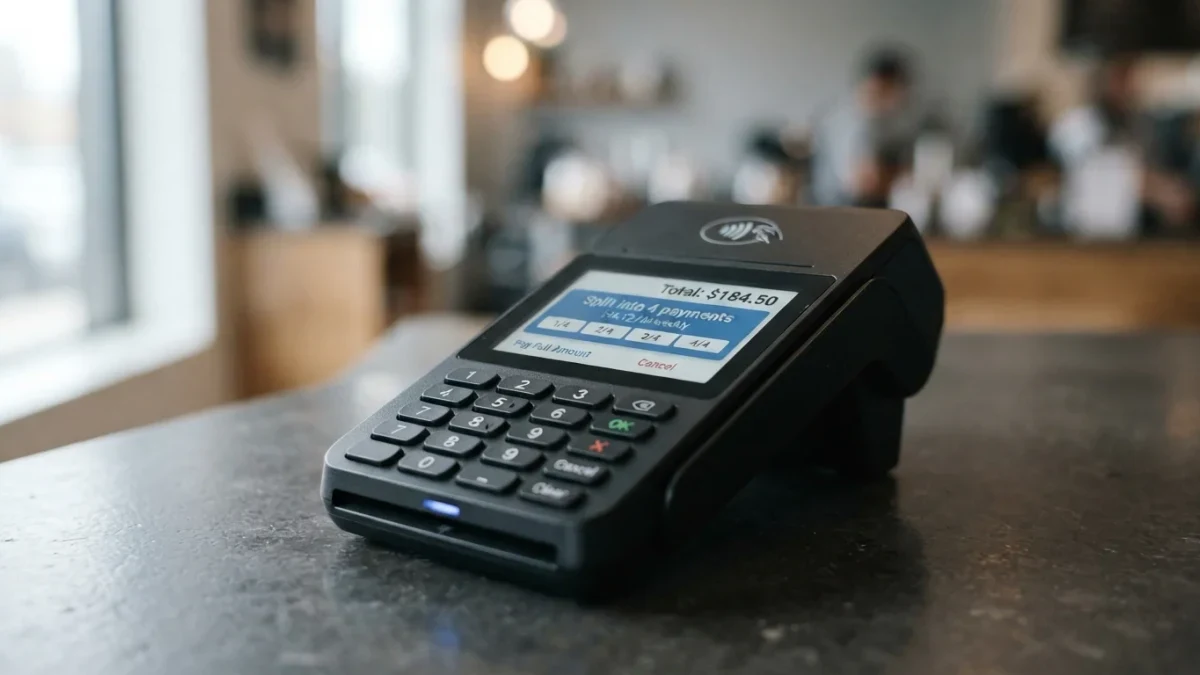
Signals in the moment. A BNPL approval typically uses a soft credit pull, which does not affect the score, combined with data the card issuer never sees: the merchant, the cart contents, the basket size, the time of day and the borrower's repayment history inside that same network.
The decision is per-transaction, not per-line. There is no credit limit to assign, because each purchase gets its own schedule, commonly four installments over six weeks with the first due at checkout. Recovery runs through a linked debit card or bank account, which gives the provider a direct collection path and a real-time signal when the funding account is empty.
The trade-off is thinness. A first-time BNPL borrower with a thin credit file can be approved in seconds because the provider prices the purchase, not the person's whole balance sheet. Scale made that defensible: the five firms surveyed by the CFPB in 2022 originated 180 million loans totaling $24.2 billion in 2021, roughly ten times 2019's volume, per the CFPB's September 2022 report.
How Does Pay-in-4 Differ From Longer BNPL Credit?
Pay-in-4 is a zero-interest installment sale; longer BNPL is a loan. The standard product charges the merchant a fee and the consumer nothing beyond the purchase price, with short schedules. Longer-duration financing, months or years with interest, is typically originated by a partner bank, such as WebBank for Klarna's US financing and Cross River Bank for Affirm, per the companies' disclosures.
Fee behavior diverges too. Affirm states it charges no late fees at all, recovering through payment rescheduling instead. Klarna's US disclosures cap late fees per installment, a structure regulators have cited when comparing BNPL with card penalty pricing. Underwriting depth rises with duration: a six-week split may clear on a soft pull alone, while a 36-month plan approaches consumer-loan scrutiny.
The regulatory perimeter, however, stayed card-shaped for exactly one year. The CFPB's interpretive rule at 89 FR 47068 applied Regulation Z's credit-card provisions, including dispute and refund rights, to pay-later products from May 2024, then withdrew that rule on May 12, 2025, at 90 FR 20084, per the Federal Register.
How Is BNPL Data Entering Credit Files?
Through new scores and tradelines. FICO unveiled FICO Score 10 BNPL and FICO Score 10 T BNPL, scoring models trained on pay-later repayment history, with availability expected from fall 2025, offered alongside existing scores rather than replacing them, per FICO's 2025 announcement.
For underwriters this changes both sides of the table. Card issuers gain visibility into repayment behavior that never reached bureaus before, while BNPL providers gain a portable risk currency beyond their proprietary history. A borrower who quietly services twenty pay-in-4 plans a year becomes countable, which cuts against the accumulation concern the FHA raised in its June 24, 2025 request for information at 90 FR 26824.
Adoption is the open variable. New scores enter production only as bureaus distribute them and lenders validate them against their own books, so files built on card history will dominate decisions for a while yet.
What Happens When Each Model Underwrites Badly?
Card losses compound; BNPL losses resolve fast. A distressed revolver accrues interest, fees and months of exposure before charge-off, while a missed pay-in-4 installment either recovers through the linked debit account or writes off the remaining balance within weeks. There is no interest cushion to absorb the error.
That speed disciplines approval models, but it also hides distress from the credit system, since charge-offs that never touch a bureau file let an overextended borrower keep approving elsewhere. The FHA's housing-focused inquiry and the bureau scores now arriving both target that blind spot, and each closes it differently.
The competitive result sits at checkout. Approval rate is part of the merchant pitch, so BNPL underwriting is tuned to accept more borderline baskets than a card issuer would accept applications, and the merchant fee subsidizes that tolerance. As of May 2026, no successor to the withdrawn 2024 rule had been published in the Federal Register, so this remains the operating baseline.
Until that changes, the practical comparison stands: card underwriting prices a person, BNPL underwriting prices a basket, and the credit system is only beginning to reconcile the two.