Since March 19, 2021, NACHA operating rules have required originators to validate consumer accounts before the first WEB debit, and two methods dominate the market: instant account verification through credential-based data networks and the older micro-deposit challenge. The compliance rule, combined with conversion pressure, pushed most consumer payment flows toward the instant path.
How Do Micro-Deposits Verify an Account?
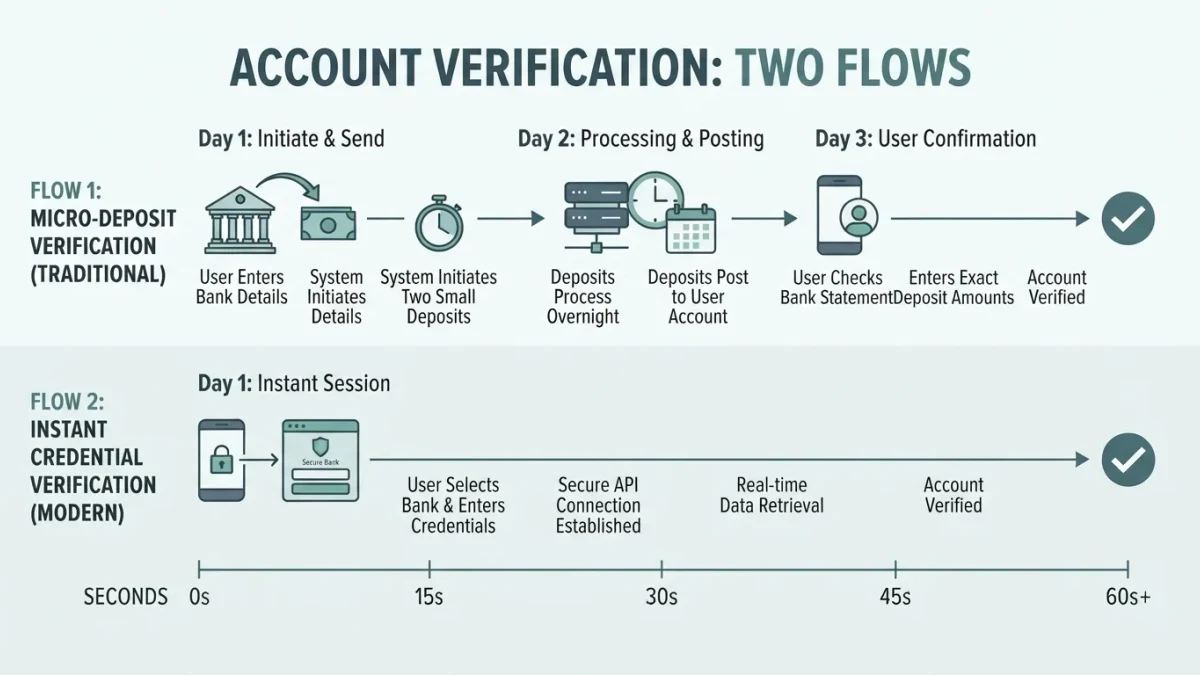
By proving the user can see money arrive. The biller or platform sends two small ACH credits, typically a few cents each, to the account the user typed in. When the user correctly reports both amounts, the platform treats the account as real, open and controlled by that user.
The bottleneck is ACH timing. A standard credit initiated today posts to the receiving account on the second business day under NACHA's settlement schedule, so the user returns a day or two later to finish verification, and total elapsed time often reaches two to four days. Same-day ACH, available for credits since September 2016 per NACHA rule changes, can compress posting to hours for eligible files, but the user still has to come back a second time.
Micro-deposits remain a valid validation method under the NACHA WEB-debit rule, alongside prenotifications, in which the originator sends a zero-dollar entry to test the routing and account number combination before live debits begin.
Operations teams also pay for the format's quirks. Credits sent to closed or mistyped accounts return as notifications of change that someone must work; dormant users leave half-finished links in the database; and support queues field calls from customers puzzled by two unexplained cents on a statement. None of this is fatal, but each item prices the slowness that instant verification removes.
How Does Instant Account Verification Work?
By logging in as the user, with the user's consent. The platform hands off to an account-data network such as Plaid, Finicity or MX, the user enters online-banking credentials in that module, the network authenticates against the bank, then returns verified account and routing numbers, ownership signals and balance data within seconds.
The infrastructure consolidated quickly. Mastercard completed its $825 million acquisition of aggregator Finicity in 2020, per Mastercard's announcement. Plaid raised a $425 million Series D at a $13.4 billion valuation on April 7, 2021, after Visa's planned $5.3 billion purchase was abandoned, per CNBC, and Plaid's network connects to roughly 12,000 financial institutions, per the company.
The output is the same artifact micro-deposits produce, a validated account and routing pair, plus richer data: ownership checks, live balances and transaction history that underwrite risk decisions. Modern flows usually keep the account number tokenized, so the platform references an account token rather than storing raw credentials.
Which Method Converts Better?
Instant verification, in most consumer funnels, because it removes the second visit. Micro-deposit funnels ask users to return one to two days later to report two cents amounts, and a share of any audience simply never comes back. Aggregators market the difference openly as a conversion product, and their claims should be read as vendor statements rather than independent measurements.
Instant flows have their own friction. Multi-factor authentication prompts, forgotten passwords and bank maintenance windows all interrupt the credential handoff, and business accounts with role-based logins frequently fail. Well-built funnels therefore treat instant verification as the default with a micro-deposit fallback for unsupported institutions.
Speed also changes the revenue side of the ledger. A verified account linked in one session enables an immediate first debit or funding transfer, while micro-deposit flows leave money uncollected for days. For subscription and lending products, that gap is measurable in both churn and fraud losses.
What Are the Fraud Trade-Offs?
The two methods prove different things. A micro-deposit proves control of the receiving account, because only someone with access can read the amounts. Credential-based verification proves control of the online banking identity, which is usually, but not always, the account owner: phished credentials, SIM-swapped one-time codes and shared logins can all pass an instant check.
That distinction shapes architecture. High-risk mandates, large recurring debits and payouts often add a second signal, such as a penny-test to the exact account, ownership screening against bureau data, or velocity rules on newly linked accounts. The NACHA rule requires validation once per new consumer WEB debit relationship, not continuous re-verification, so ongoing risk is managed at the platform layer.
Data-network risk sits one layer deeper. Aggregators authenticate to thousands of bank endpoints, and an outage at a large bank degrades every platform relying on that connection for onboarding. This concentration is why payment teams monitor aggregator status pages with the same seriousness once reserved for card-network availability.
How Do Teams Deploy Both Methods Together?
A waterfall is the standard pattern: attempt instant verification first, offer micro-deposits as the fallback, and log which path each user took for risk scoring. Business banking relationships, which credential flows handle poorly, often route directly to the micro-deposit or prenotification path.
Regulation is converging on the data networks too. The CFPB's Section 1033 rule, finalized in October 2024, requires covered institutions to release consumer account data to authorized third parties through interfaces, a shift that would standardize the connections aggregators currently assemble bank by bank, per the Federal Register's published rule.
Until such interfaces are universally live, the practical rule for payments teams is unchanged: instant verification buys conversion and speed, micro-deposits buy certainty about the receiving account, and mature fraud programs keep both in production with explicit criteria for routing between them.