
A Federal Reserve master account is a settlement account at a Reserve Bank, and access is tiered: on March 4, 2026, the Federal Reserve Bank of Kansas City granted Kraken subsidiary Payward Financial a limited-purpose master account, the first for a digital asset firm, per press reports and the company — after a Fed Board denial in January 2025.
Nuv Media publishes information, not financial advice.
What Is a Master Account, Actually?
A master account is an account a financial institution holds directly at a Federal Reserve Bank, in which it keeps reserve balances and settles payments. Direct access lets an institution send and receive wire transfers and other interbank payments in central bank money without routing through a correspondent bank that holds the account on its behalf.
The Federal Reserve maintains a public database of master account holders and publishes periodic data reports on approvals and denials. For most of the system's history the account was plumbing that insured banks took for granted; after 2020, it became one of the most contested privileges in financial regulation.
How Did the Fed's Tier System Come About?
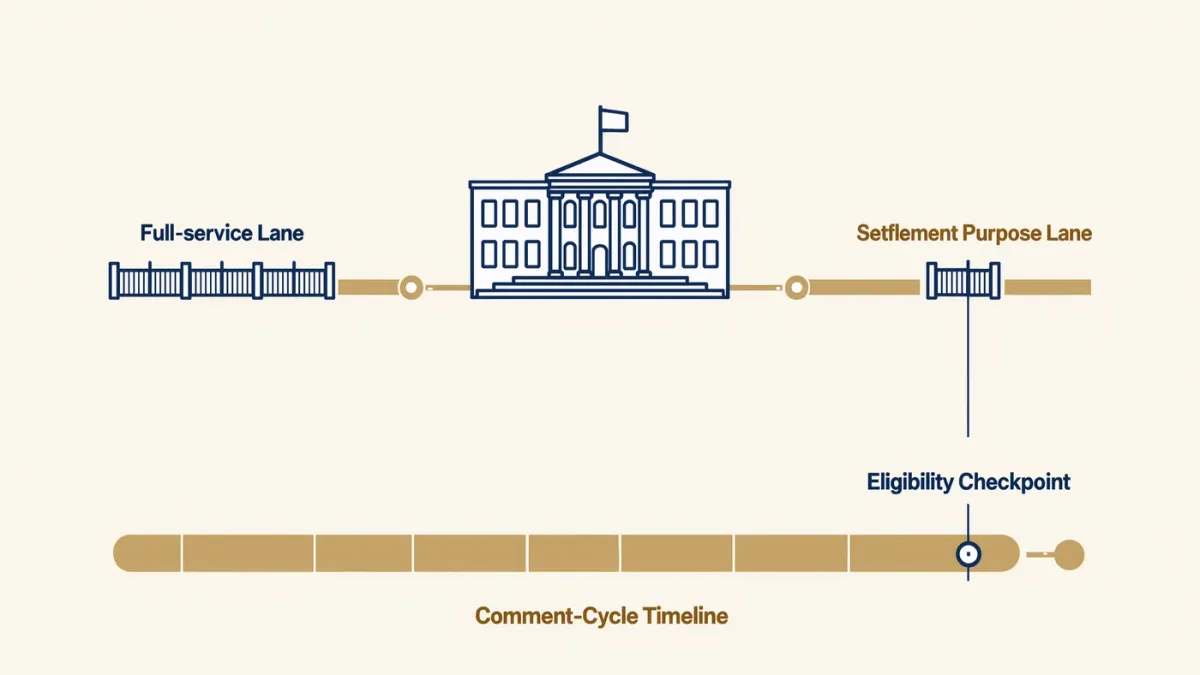
The framework dates to August 2022, when the Fed Board finalized its Guidelines for Evaluating Account and Services Requests after a proposal first circulated in 2021. The guidelines sort requesters into three tiers. Tier 1 covers federally insured institutions — banks and credit unions — which receive the most streamlined review. Tier 2 covers institutions that are not federally insured but are subject to federal prudential supervision. Tier 3 covers everyone else: uninsured institutions with no federal prudential supervisor, which face the most intensive review.
Custody balances were part of how the Fed drew those lines. The 2021 proposal used custody-balance metrics to distinguish institutions that should fall into tighter review tiers, and the final guidelines simplified the tier definitions while keeping the risk-based logic: the less federal supervision sits behind an institution, the more the Reserve Bank must supply itself.
What Does Tier 3 Scrutiny Involve?
For a Tier 3 requester, the Reserve Bank effectively becomes the supervisor the institution lacks. The guidelines direct review of capital and liquidity, governance, information-sharing with state regulators, and the requester's actual need for direct access. Approval can carry conditions, and account holders should expect ongoing reporting requirements once granted.
That structure explains why the Kraken account is described as skinny: reporting indicates the Kansas City Fed approved a limited-purpose account with restricted functionality rather than the full access an insured bank receives. The tier system does not merely gate entry — it grades the level of access an institution gets after the gate opens.
How Did Custodia and Kraken Test the Framework?
Custodia Bank, a Wyoming-chartered institution serving digital asset customers, applied for a master account in 2020 and was denied by the Fed Board on January 23, 2023. Custodia sued, and in March 2024 the US District Court in Wyoming ruled for the Federal Reserve, per court records and contemporaneous legal analysis.
The Kraken path was longer and stranger. Payward applied in June 2020 through its Wyoming-chartered subsidiary, and the Fed Board issued an order denying the application on January 6, 2025, per the Fed's published order. Fourteen months later, on March 4, 2026, the Kansas City Fed granted the same family of entities a limited-purpose master account — the first Federal Reserve account held by a digital asset firm, per press reports and the company's announcement.
Limited purpose is an operational category, not a press adjective. A restricted account of this kind covers a defined set of settlement functions with conditions attached, rather than the full menu of payment services an insured bank draws on. Press reports indicated the account remained non-operational for a period after approval while implementation details were worked through — a reminder that the grant itself is the beginning of the operational build, not the end.
Why Do Fintechs and Custodial Banks Want Direct Access?
Because the alternative is a correspondent. An institution without a master account must settle through another bank's account, which adds fees, settlement lag, counterparty exposure, and — the part fintechs felt most — the correspondent's risk appetite. A partner bank can exit a fintech program overnight; a master account cannot be exited from underneath you.
Custodial banks have a parallel interest: they settle large customer flows and want those movements in central bank money without intermediation. The Fed's own rationale for the tier system acknowledged the tension — the Payment System Policy Advisory Committee flagged that broadening access spreads the Fed's balance-sheet and supervisory exposure, which is precisely what the 2022 guidelines were built to manage.
How Many Accounts Are There, Really?
Fewer than the industry's size suggests, and shrinking slowly as consolidation proceeds. The Fed's 2023 master account data report showed one approval and two denials during the year, per The Clearing House's summary of the report — a trickle, not a door opening. The overwhelming majority of account holders are federally insured banks in Tier 1.
That scarcity is the point. A master account is a supervisory judgment about who can hold central bank money directly, and the 2022 guidelines, the 2023 Custodia denial, the 2025 Payward denial, and the 2026 limited-purpose grant together sketch the actual policy: insured banks get routine access, novel charters get scrutiny, and access without a federal supervisor comes graded and conditional. The next Tier 3 application will be read against that record.