Opening a bank account in the United States does not require a credit score, a job title, or a minimum deposit at most institutions. It requires proof of who you are, a way to reach you, and a small opening deposit at many banks. The main obstacle for first-timers is not eligibility. It is knowing which documents to bring and what happens when a past account problem surfaces.
This guide walks through the process in order: choosing an account type, gathering identification, applying online or in person, and handling the two most common rejections. It also covers the options for people with thin credit or a record of closed accounts, where the standard application path often fails.
What do you actually need to open a bank account?
Banks are legally required to verify your identity, so the checklist starts there. In practice you will need a government-issued photo ID such as a driver's license, state ID, or passport. Most banks also ask for a second identifier, which can be a Social Security number or Individual Taxpayer Identification Number, plus a physical address and a phone number or email.
An opening deposit is the other near-universal requirement. The amount varies widely by institution, and some online banks and credit unions open accounts with no minimum at all. If cash is tight, that is worth checking before you apply, because the deposit is the one requirement you cannot talk your way around at the counter. This connects to our earlier piece, Why Online Banks Pay More on Savings Than Branch Networks.
One point confuses many first-timers: a checking account and a savings account are separate products with separate applications. If you want both, expect to open each one, even at the same bank on the same visit.
How does the application actually work?
The process is short once your documents are in hand. Most applications follow the same sequence.
- Choose the account and confirm any minimum opening deposit before you start.
- Submit your identifying details: legal name, address, date of birth, and taxpayer identification number.
- Upload or present your photo ID. Online applications usually ask for images of the front and back.
- Fund the account with a transfer, a mobile check deposit, cash at a branch, or a debit card from another institution.
- Set up online access, including a username, password, and any additional security step the bank offers.
The online experience is now the default at large banks. For example, Chase describes its online banking as giving customers control over statements, account activity, bill payment, check images, and transfers, with encryption protecting personal information such as user IDs and passwords. That matters for a first account: once you are approved, nearly everything else — checking balances, depositing checks, moving money — happens in the app rather than at a branch.
What do banks check besides your ID?
Here is the part nobody explains up front. Most banks do not pull your credit report when you open a checking account. They check a different file: a specialty consumer reporting database that tracks deposit account history. The best-known of these is ChexSystems, and some banks use competitors such as Early Warning Services instead.
These databases record things like accounts closed with a negative balance, unpaid overdrafts, suspected fraud, and accounts closed involuntarily by the bank. A record there can trigger a decline even with a spotless credit history. This is why the question "can I open a bank account with bad credit?" usually has the wrong frame. Your credit score is rarely the issue. Your account history is.
If you have never had an account, this works in your favor. A thin file at a specialty reporting agency is not a negative entry. First-timers with no banking history are typically approved on identity verification alone.
What are your options if you have been declined before?
A past account closure is a real obstacle, but it is not a permanent one. Three paths exist, in rough order of cost to you.
- Second-chance checking accounts. Some banks and many credit unions offer accounts designed for applicants with negative reporting records. They skip the database screen or apply lighter criteria. Expect trade-offs: some limit overdraft features or charge a monthly fee that is harder to waive.
- Disputing an error. If your record shows a debt you do not owe, or a balance you already repaid, you can request a free copy of your report from the reporting agency and dispute the entry. Corrections can clear the way for a standard application.
- Waiting it out. Negative entries generally fall off these reports after several years. If the record is old and accurate, time may resolve it without action on your part.
Credit unions deserve a specific mention. Membership rules have loosened across the industry, and many credit unions serve broad geographic or occupational groups. Their second-chance accounts are often the cheapest entry point back into the system, because credit unions are member-owned and tend to price fees lower than shareholder-owned banks.
What should you check before you commit?
Approval is the start of the relationship, not the end of your homework. Four items on the fee schedule deserve a close read before you fund the account.
- Monthly maintenance fee and, more importantly, how to waive it. Common waiver conditions include a direct deposit of a set size, a minimum balance, or a linked account.
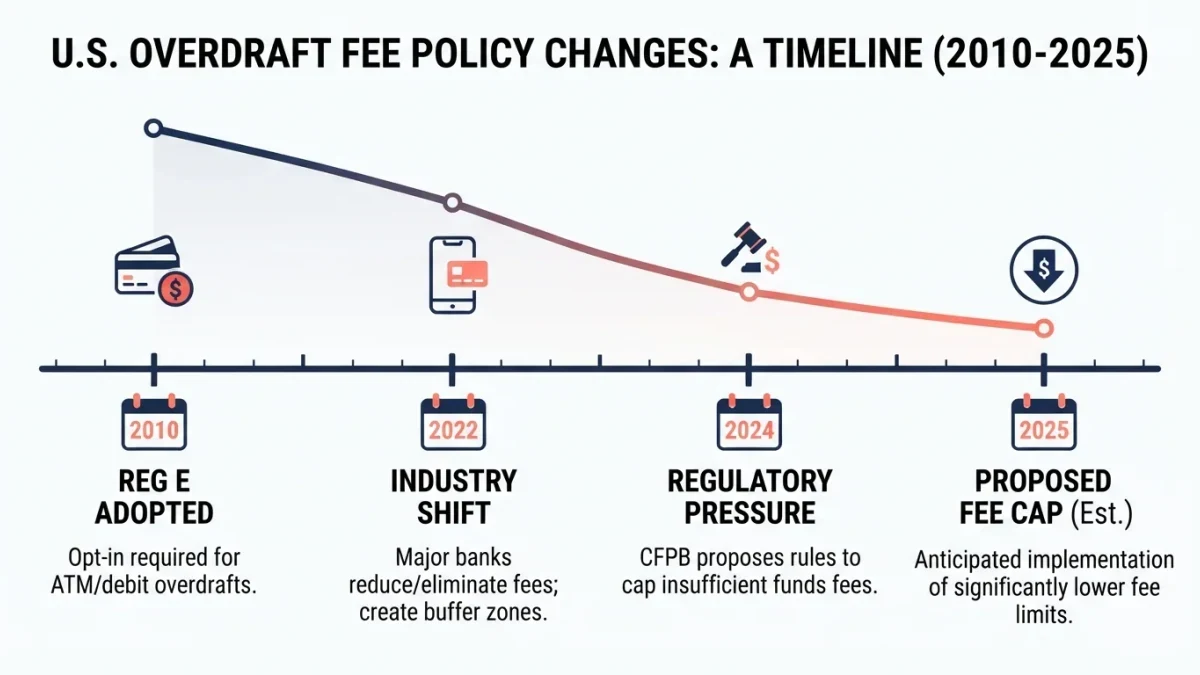
- Overdraft coverage. The mechanics changed industry-wide after banks began cutting these fees, and the details still vary a lot by institution. Our explainer on how overdraft fees work and what changed covers the current mechanics.
- Out-of-network ATM fees, both the bank's charge and the ATM operator's surcharge, which are separate.
- Interest, if any. Online banks generally pay more on savings than branch networks, a structural difference we explain in why online banks pay more on savings.
Deposits are also protected. Accounts at banks insured by the Federal Deposit Insurance Corporation are covered up to the standard insurance limit per depositor, per ownership category, per bank. Credit unions carry equivalent protection through the National Credit Union Administration. If an institution is not on one of those two lists, keep looking. Our guide to how neobanks without charters move and insure customer money explains the extra layer to check when the app is not the actual bank.
Practical steps: a first-week checklist
Once the account is open, a few moves in the first week set up everything after it.
- Set up online and mobile access, and turn on the strongest login security the bank offers.
- Route your paycheck or benefits by direct deposit. This often waives the monthly fee and gives you a consistent record of income.
- Check whether the account has a minimum balance requirement, and set a low-balance alert if the app supports one.
- Order a debit card and confirm how you will access cash without fees, either through the bank's ATM network or cash-back at purchase.
- Read the overdraft settings and choose the option you understand. Doing nothing is itself a choice, and usually the expensive one.
None of this requires financial sophistication. It requires ten minutes with the fee schedule and a phone with the bank's app on it.
Where this leaves first-timers
The evidence here points to a simple picture: the barrier to a first bank account is documentation and account history, not credit. Bring a government ID, a taxpayer identification number, and an address you can verify, and most standard applications go through. If a past closure blocks the standard path, second-chance accounts and credit unions exist precisely for that situation, and disputing an inaccurate record is free.
What remains genuinely variable is cost. Fee schedules differ enough between institutions that two people with identical profiles can pay very different amounts for the same service. That comparison, not the application itself, is where the real work of choosing a bank happens — and it is worth doing before the opening deposit, not after.