The average overdraft fee still runs about 27 dollars per transaction, per Bankrate's checking survey, even after Capital One, Citibank, Ally, and American Express eliminated the fee entirely. Congress repealed the CFPB's 5 dollar cap in 2025 before it took effect — leaving bank-by-bank policy, not regulation, as the operative fee regime.
How Does an Overdraft Actually Work?
An overdraft occurs when a bank pays a transaction that exceeds the available balance, pushing the account negative and covering the difference. The bank then charges a fee per item, and the account must be brought back to positive, sometimes with additional sustained-overdraft fees if the deficit persists. It is short-term credit extended at the moment of the payment decision, priced as a flat fee rather than an interest rate.
The cousin product is the non-sufficient funds fee, where the bank returns the item unpaid and charges for the refusal. The economics differ — one extends credit, the other declines it — but both price the same event: a payment presented against money that is not there.
How Do Fee Stacking and Daily Caps Compound the Cost?
The per-item structure is what makes overdraft expensive: a day of several small purchases can trigger several fees, each priced as if it stood alone. Fee schedules set the ceiling through daily maximums — a cap of four or five fees per day is a common structure — and many banks add sustained-overdraft fees when an account stays negative past a stated number of days.
Posting order used to multiply the effect. Banks historically posted the day's largest transactions first, maximizing the number of items that overdraw; regulators pressed the industry toward chronological and other neutral orders during the 2010s, and disclosure of the practice is now standard. Reading a fee schedule means reading three numbers together: the per-item fee, the daily cap, and the sustained-balance trigger.
What Has Regulated Overdraft Since 2010?
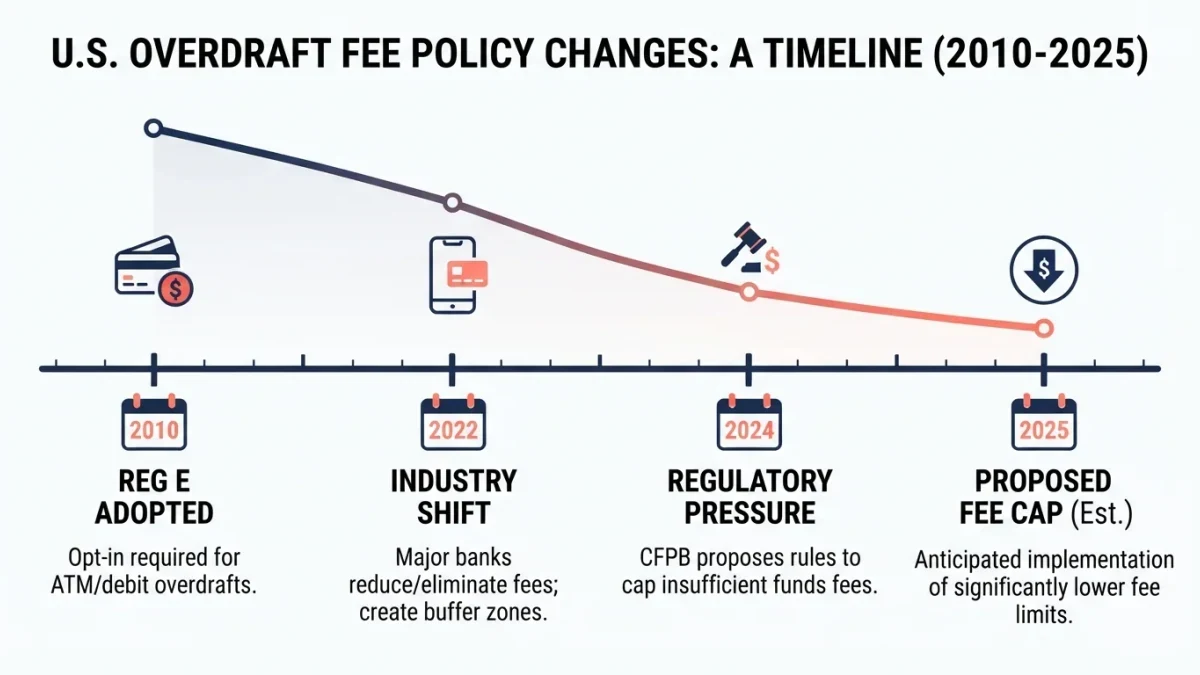
One federal rule: the Federal Reserve's amendment to Regulation E, effective in 2010, prohibits overdraft fees on ATM transactions and one-time debit card purchases unless the customer has opted in. Recurring debit transactions, checks, and ACH debits are not covered by the opt-in requirement — a bank can charge for overdrawing those without separate consent, which is where most fee volume historically sat.
The rule restructured the market's worst edge — debit swipes at the point of sale — and left the rest to disclosure and bank policy. Everything since 2010 has been a fight over that remainder: checks, ACH, and the fee levels themselves.
What Did the CFPB Try to Impose?
In December 2024, the CFPB finalized its overdraft lending rule for institutions with 10 billion dollars or more in assets, per the rule text. Banks would have had to cap the fee at 5 dollars, limit it to a breakeven calculation of actual costs and losses, or treat overdrafts as credit with lending-law disclosures. The effective date was set for October 1, 2025, with the bureau projecting roughly 5 billion dollars in annual consumer savings.
It never took effect. Banks sued, and in 2025 Congress passed a Congressional Review Act resolution overturning the rule — the House voted in April 2025, per the American Bankers Association's Banking Journal, and the Senate followed — with the Congressional Research Service documenting the repeal. The regulatory baseline reverted to the 2010 opt-in rule plus disclosure law.
What Did Banks Change Voluntarily?
Starting in 2022, several large banks rebuilt overdraft economics on their own. Capital One, Citibank, Ally, and American Express eliminated overdraft fees entirely, per Bankrate's tracking of bank fee policies. Bank of America eliminated NSF fees and cut its overdraft fee from 35 to 10 dollars in 2022, and other majors reduced fees or added grace periods and buffer amounts.
The stakes were material. Overdraft and NSF fees peaked above 12 billion dollars annually across the industry, per estimates from the National Consumer Law Center — revenue that concentrated heavily among accounts that overdrew repeatedly. The voluntary cuts preceded the CFPB rule and survived its repeal; the largest banks are mostly pricing below the old 35 dollar standard regardless of what regulation requires.
What Do Fees Look Like Now?
The distribution is wide. Bankrate's checking survey puts the average overdraft fee at about 27 dollars per transaction, with some institutions charging up to about 39 dollars, and the FDIC's consumer materials have long cited fees of about 35 dollars as common at larger banks. Fee schedules, caps on daily counts, and grace windows vary bank by bank, which is the practical consequence of the post-repeal regime.
Two structural trends sit under the averages. Fee elimination has decoupled overdraft access from overdraft revenue at the largest consumer banks — an account can overdraw for free where the fee once priced the credit. And where fees persist, per-item pricing still translates into triple-digit annualized percentage rates on typical negative balances, the arithmetic that made overdraft a policy target in the first place.
Where Does Overdraft Policy Go From Here?
The current state is fragmented by design. Federal law mandates opt-in for ATM and one-time debit overdrafts, disclosure rules govern the rest, and nothing caps fee levels. State-level measures and bank-level product choices set the boundaries customers actually experience, and the gap between an eliminated-fee bank and a 39 dollar fee bank is now wider than any single regulatory number.
For payments professionals, the operational takeaway is to read the fee schedule, not the headline: what triggers the fee, whether a buffer exists, how many fees can stack in a day, and whether negative balances must be cured within a set window. Those four parameters — not the average — describe what any given account's overdraft actually costs.