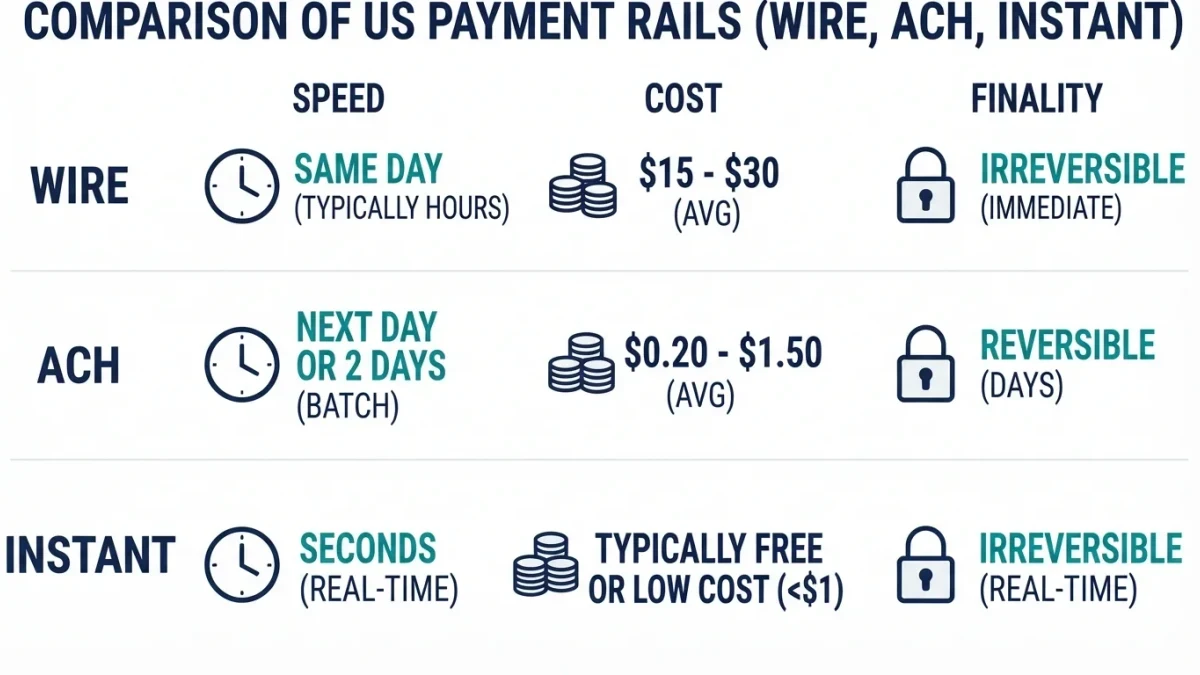
The Federal Reserve prices instant settlement at 4.5 cents: the FedNow Service charges banks 0.045 dollars per credit transfer under its published fee schedule, while Fedwire Funds per-item fees run from roughly 0.16 to 0.53 dollars depending on volume tier. Rail selection is a cost-and-finality decision before it is a product decision.
How Do the Three Rails Compare at a Glance?
Each rail answers a different operational question. Fedwire answers whether money can settle immediately and finally at any value. ACH answers how to move recurring payments at the lowest cost per item. RTP and FedNow answer whether money can move instantly around the clock. The table below sets out the mechanics that drive those choices.
| Rail | Speed and availability | Interbank cost | Finality | Operational fit |
|---|---|---|---|---|
| Fedwire Funds | Real-time gross settlement, business days only | Roughly 0.16 to 0.53 dollars per item, volume-tiered, per Federal Reserve fee schedules | Immediate, final, irrevocable | High-value and deadline-critical payments, such as real estate closings and treasury settlements |
| ACH | Next-business-day settlement standard; same-day ACH adds three same-day windows | Fractions of a cent per item at the interbank level, per FedACH fee schedules | Conditional; entries remain returnable under Nacha rules | Payroll, vendor payments, recurring debits and credits at scale |
| RTP | Instant, 24 hours a day, 365 days a year | Set bilaterally by network and bank contracts | Immediate finality | Instant account-to-account payments, earned wage access, request-for-payment billing |
| FedNow | Instant, 24 hours a day, 365 days a year, in central bank money | 0.045 dollars per credit transfer, plus a 25 dollar monthly participation fee per routing number, per the Fed schedule | Immediate final settlement | Instant payments where Fed settlement is preferred; 500,000 dollar default per-payment cap |
What Does Each Rail Actually Cost?
At the interbank level the spread is wide. The FedNow schedule prices a customer credit at 0.045 dollars per item, with a request-for-payment message at 0.01 dollars and a 25 dollar monthly participation fee per routing number, per the Federal Reserve's published fees. Fedwire Funds charges both sender and receiver a volume-tiered per-item fee of roughly 0.16 to 0.53 dollars, per the same schedules.
ACH is the cheapest rail because batch netting amortizes fixed processing across thousands of entries. Federal Reserve FedACH fee schedules price the interbank per-item cost in fractions of a cent. What a corporate or retail customer ultimately pays, on any rail, reflects the bank's own markup, service bundling, and risk pricing rather than the interbank fee.
How Fast Does Each Rail Move Money?
Fedwire settles gross and in real time, but only on business days: the service operates from 9:00 p.m. Eastern time on the preceding calendar day until 6:30 p.m. Eastern time on each business day, per the Federal Reserve. Standard ACH settles on the next business day, and same-day ACH adds three same-day settlement windows on business days under Nacha rules.
RTP and FedNow are the only rails that settle instantly on nights and weekends. Nacha raised the same-day ACH per-entry limit from 100,000 dollars to 1,000,000 dollars effective March 2022, which widened same-day ACH's fit for payroll and supplier payments, but same-day entries still settle only on business days.
What Does Finality Mean on Each Rail?
Finality determines who bears a mistake. Fedwire transfers are final and irrevocable the moment they are credited, under Federal Reserve Regulation J. RTP and FedNow payments likewise settle with immediate finality, which is what makes them usable for irrevocable consumer payouts — and what makes sending-bank controls critical.
ACH is deliberately reversible. Under the Nacha Operating Rules, receiving institutions can return entries, and unauthorized consumer entries may be returned within 60 days of settlement. That return window is why ACH dominates billing and payroll: the originator keeps correction rights, and the receiver keeps dispute rights, at the cost of finality.
When Is a Wire the Operationally Right Choice?
Wires earn their fee when value and certainty dominate cost. Real estate closings, interbank treasury movements, securities-related settlements, and large supplier payments that must be good the same business day all run on Fedwire because gross settlement in central bank money removes counterparty exposure at the moment of transfer.
The operational price is overhead: wire rooms run verification callbacks against fraud, cutoff times compress late-day operations, and business-day-only availability fails on weekends. A wire sent after the cutoff settles the next business day, at which point an instant rail may have been the better design from the start.
When Does ACH Fit Better?
ACH fits whenever volume is predictable and cost per item matters more than speed. Payroll files, insurance premiums, subscription billing, mortgage payments, and business-to-business invoicing move in batches, net across participants, and carry return rights that support dispute handling. The Nacha network processed record volumes in 2024, per Nacha's annual reporting, reflecting the rail's continued growth.
The design constraint is timing. Standard entries settle the next business day, same-day windows close early in the afternoon Eastern time, and nothing settles on weekends or federal holidays. Any product promising weekend batch settlement is not settling through ACH.
When Do RTP and FedNow Make Sense?
Instant rails fit when the payment event is time-sensitive for the recipient: earned wage access, instant account funding, insurance claim payouts, and request-for-payment billing where the biller wants same-conversation settlement. Both networks settle 24 hours a day, 365 days a year, and finality is immediate, per The Clearing House and Federal Reserve rules.
Two constraints shape adoption. Reach is incomplete: both sender and receiver institutions must be connected, and instant-rail coverage is still narrower than ACH coverage. And FedNow's default 500,000 dollar per-payment cap, per the Federal Reserve, means high-value flows stay on wires. The practical pattern in 2026 is layered: wires for large value, ACH for scheduled volume, instant rails for time-of-need payments.