
The FDIC's national average savings rate has run below half a percent — it stood at 0.46 percent in February 2024, per the FDIC — while the largest online banks kept paying above 4 percent APY, per Bankrate's high-yield savings tracking. The gap is cost structure and competition, not generosity: the federal insurance behind both channels is identical.
Nuv Media publishes information, not financial advice.
How Does the Fed Funds Rate Set the Ceiling?
Every savings rate is anchored to the federal funds target range, which the Federal Reserve lowered to 3.50 to 3.75 percent in December 2025, per the Fed's open market operations record. A bank funding itself at the margin will not pay savers materially more than it could borrow wholesale, and it will not pay less than it must to hit its growth target.
What differs between channels is transmission speed. Online banks reprice advertised yields within days of a Fed move because rate is their product; branch-heavy banks hold thousands of low-rate legacy balances that reprice only when customers act on them. That difference — deposit beta, in asset-liability language — is the single biggest driver of the posted-rate gap.
What Does a Branch Network Actually Cost?
Branches are fixed cost: real estate, staffing, cash logistics, compliance overhead per location. Those expenses come out of the deposit spread before any saver sees a dollar of interest. An online bank replaces the network with a rate table and a mobile app, so the money that would have gone into leases and teller lines can go into APY.
The industry keeps voting on this with its real estate. FDIC Summary of Deposits data showed branch counts falling by roughly 1,000 over the latest annual reporting period, per an American Bankers Association analysis of the 2024 survey — a consolidation trend that has run for over a decade as deposits migrate to digital channels. Every branch that closes is overhead converted into price competition.
Why Does Competition Work Differently Online?
Rate is the acquisition channel for direct banks. A branch bank competes on location, relationships, and bundled services, and pays what it must to retain convenience-driven balances. An online bank has nothing to sell but rate and experience, so its advertised APY sits within a narrow band of every other direct competitor's, and comparison sites compress that band further.
The selection effect reinforces itself. Depositors who open online accounts are precisely the ones who monitor rates and move money, so online banks can never let yields drift far below the pack without watching balances leave. The result is a two-tier market: branch savings rates that look like the FDIC's sub-half-percent national average, and online rates that cluster near the policy rate.
Is the FDIC Insurance Really the Same?
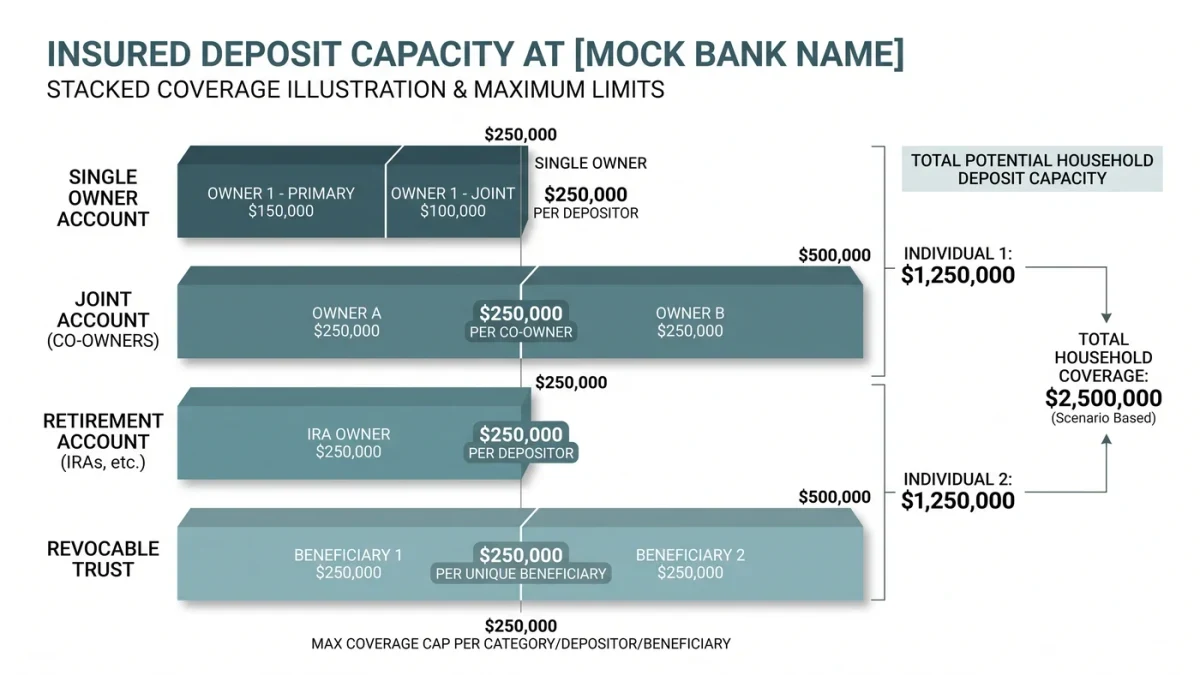
Yes, when the online bank is itself an FDIC-insured institution. The standard limit is 250,000 dollars per depositor, per bank, per ownership category, whether the account was opened in a lobby or through an app. The FDIC's BankFind Suite lists every insured institution by name, and confirming the charter is the standard operational check before moving sizeable balances.
One distinction matters: many fintech apps display FDIC insurance that actually sits at a partner bank behind the app. That is pass-through coverage, a different mechanism with different conditions. The rates those apps advertise follow the partner bank's economics, not an app-store miracle.
What Happens to Online Rates When the Fed Cuts?
Transmission runs both directions. Top online savings yields drifted down from their 2023-2024 peaks above 5 percent toward the low 4 percent range through 2025 as the Fed eased, per Bankrate's tracking of the high-yield market. Branch savings rates barely moved, because a rate near zero has little room to fall.
The margin context shows why banks can afford to pay up. The FDIC reported an industry net interest margin of 3.35 percent in the third quarter of 2025 — the spread between what banks earn on assets and what they pay for funding still comfortably covers a 4 percent promotional deposit when the money is deployed into higher-yielding loans.
How Do FDIC Rate Caps Constrain the Market?
There is a regulatory floor-and-ceiling structure underneath the two-tier market. Under the FDIC's rate cap rule, an insured institution that is not well capitalized cannot pay rates above the caps the agency publishes alongside its national averages each month. The cap exists to keep troubled banks from bidding up deposits they cannot safely fund — the 1980s savings-and-loan lesson written into current rules.
In practice, healthy online banks never approach the caps, because their pricing stays tethered to the fed funds range and to their growth targets. The caps bind only undercapitalized institutions, which is exactly the design: a bank in trouble cannot outbid the market for rate-sensitive money it may not be able to keep. For rate watchers, the FDIC's monthly national rates table doubles as a map of where the competitive floor sits.
What Are the Trade-Offs Beyond the Rate?
The mechanics have edges. Moving money in and out of an online bank typically runs over ACH, which settles next business day unless same-day windows are used, and instant rails depend on both institutions being connected. Cash deposits are awkward without a branch or retail partner network. Customer service is app and phone rather than walk-in.
None of these edges changes the rate logic, but they explain the segmentation: operational balances that need branch services sit in low-rate accounts, while rate-sensitive savings cluster at direct banks. The two-tier market is not an anomaly — it is two different funding strategies priced honestly.