A certificate of deposit is a term deposit: the customer commits a sum for a fixed period at a rate that does not move until maturity. The pricing environment is set by the Federal Reserve, which lowered its target range to 3.50 to 3.75 percent in December 2025, per the Fed. Every CD issued in 2026 prices off that curve.
Nuv Media publishes information, not financial advice.
What Is a Certificate of Deposit?
A certificate of deposit is a deposit account with a contract: a principal amount, a stated maturity, a fixed interest rate, and an early-withdrawal penalty. Banks offer maturities that commonly run from a few months to five years, with longer terms historically carrying higher yields to compensate for the commitment. In exchange for giving up liquidity, the depositor receives rate certainty that savings accounts do not provide.
On the bank's side, a CD is term funding. Because the money is contractually locked, the bank can match it against assets of similar duration without reserving for immediate runoff — which is exactly why it pays a premium over its liquid-deposit rates.
How Is the Rate Fixed and What Does APY Mean?
The rate is fixed for the term at issuance. What banks quote is an annual percentage yield — APY — which folds in the effect of compounding, so a quoted APY is directly comparable across institutions regardless of how often interest compounds. The Truth in Savings Act, implemented through Regulation DD, requires banks to disclose the APY, the maturity, and any penalty before the account is opened.
Because the rate is fixed, a CD's pricing embeds the market's rate expectations at issuance. When the Federal Reserve lowered its target range to 3.50 to 3.75 percent in December 2025, new CD offers repriced downward with the policy anchor, while existing CDs kept their issued rate — the asymmetry that term deposits exist to monetize.
What Happens at Maturity?
At maturity the contract ends and the bank enters a grace period, disclosed under Regulation DD, during which the depositor can withdraw or move the funds without penalty. After the grace period, most CDs renew automatically into a new CD of similar maturity at the bank's then-current rate — not the original rate.
Automatic renewal is where money goes quiet. The renewal rate is whatever the bank posts that week, and Regulation DD requires advance notice before maturity with the current terms. Operationally, maturity calendars — not rates — are what CD holders maintain, because the decision window is the grace period and nothing else.
How Do Early-Withdrawal Penalties Work?
Breaking a CD early means the bank applies the penalty disclosed in the contract, and Regulation DD requires that penalty to be stated before account opening. Penalties are typically structured as a set number of months of interest, scaled to the term — shorter CDs forfeit less, longer CDs forfeit more.
Three mechanics matter. First, the penalty can consume part of principal if it exceeds accrued interest, depending on the contract. Second, some banks reserve the right to refuse an early withdrawal entirely — CD liquidity is a bank policy, not a guarantee. Third, no-penalty CD products exist, trading a lower rate for an exit option; a bank prices that option into the yield, which is why no-penalty offers sit below comparable fixed terms.
How Does CD Laddering Work?
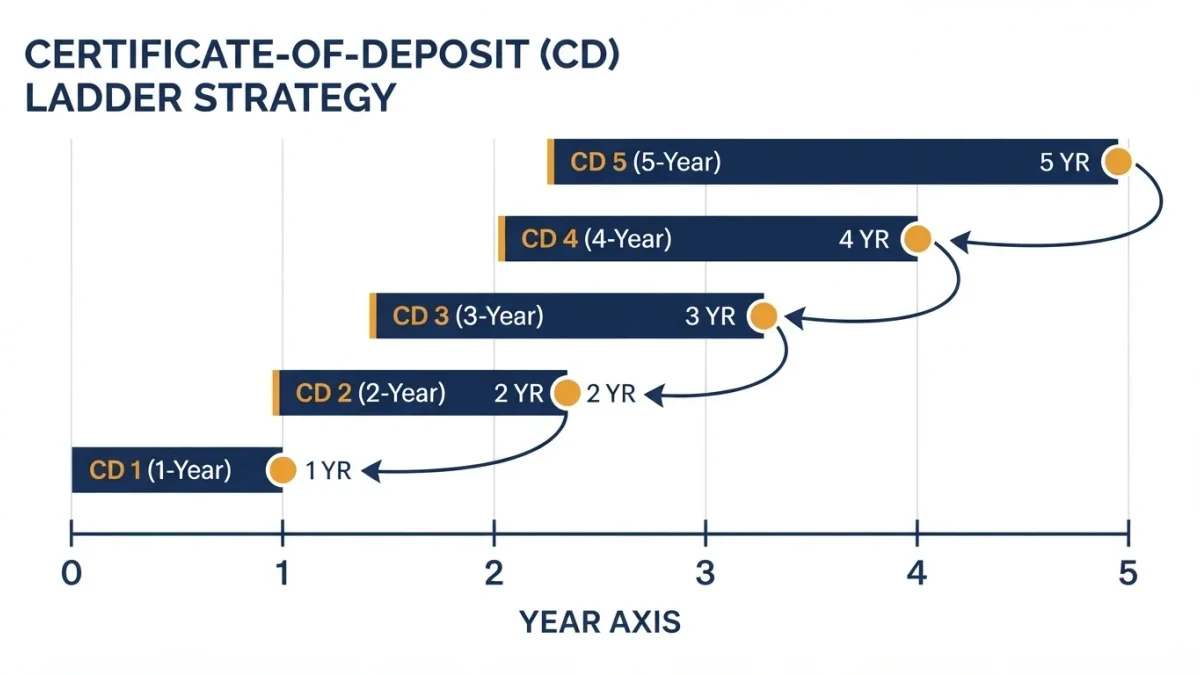
A ladder is a scheduling structure, not a product. The depositor divides the total sum into equal tranches and buys CDs with staggered maturities — a five-rung ladder might hold one-year through five-year terms. As each rung matures, the principal is reinvested at the longest rung, keeping the ladder's spacing intact.
The mechanics produce two effects. Liquidity arrives on a fixed cadence, since one tranche matures every interval, so a portion of the money becomes available without penalties. And the blended rate averages across vintages — when rates rise, maturing rungs reinvest higher; when rates fall, existing rungs hold their fixed terms. A ladder is a way to schedule reinvestment risk, which is a different thing from eliminating it.
Where Do Callable and No-Penalty Variants Fit?
Two product variants trade optionality in opposite directions. A callable CD gives the bank the right to redeem the CD before maturity, typically after an initial call-protection period — the bank buys an exit if rates fall, and pays a higher rate for it. The depositor's yield premium is compensation for taking redemption risk on the issuer's schedule.
A no-penalty CD gives the depositor the exit instead: funds can be withdrawn in full without the penalty, and the rate sits below comparable fixed terms. Neither variant changes the underlying mechanics of term funding — they just allocate the early-exit option to one side or the other, and the rate spread between the variants is the visible price of that option.
How Does FDIC Insurance Apply to CDs?
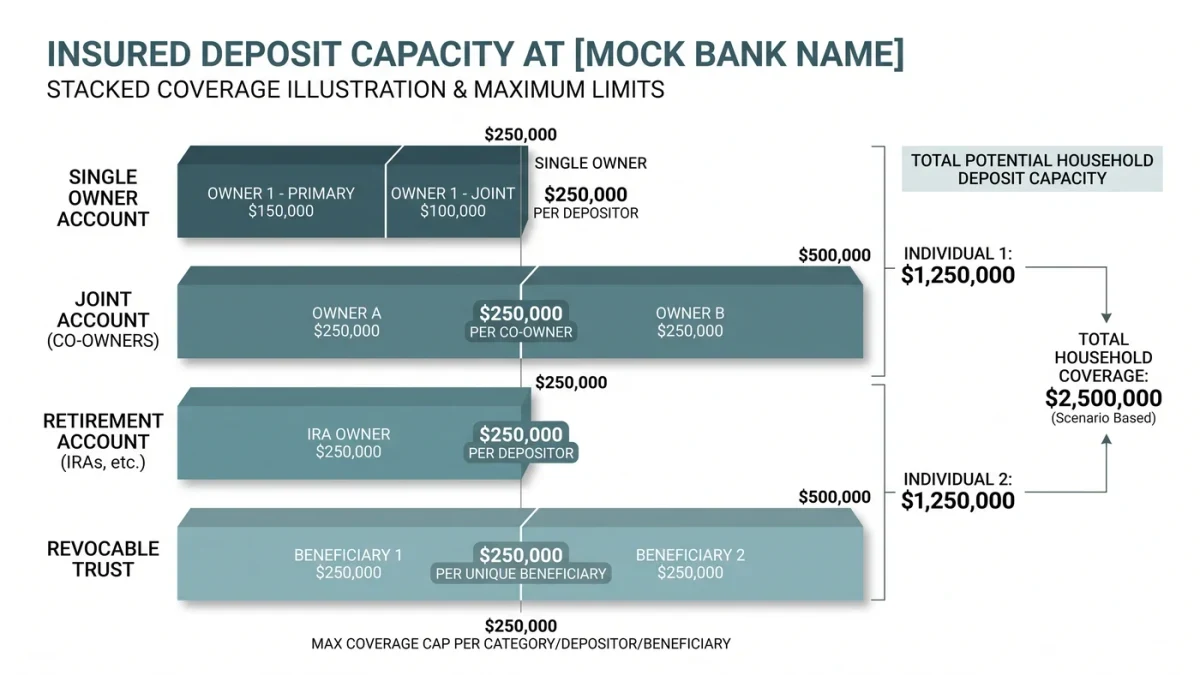
Certificate of deposit balances are deposits, insured up to 250,000 dollars per depositor, per bank, per ownership category — the same standard limit that governs checking and savings. Insurance attaches to the issuing bank, not to where the CD was bought.
That last point drives the brokered CD market. A brokered CD is issued by an FDIC-insured bank but sold through a brokerage, and the insurance comes from the issuer, up to the same 250,000 dollar line, with coverage depending on how the position is titled and aggregated with other deposits at that bank. Large depositors structure CD holdings across institutions to stay within limits per bank — the insurance line, not the rate, is usually the binding constraint on size.