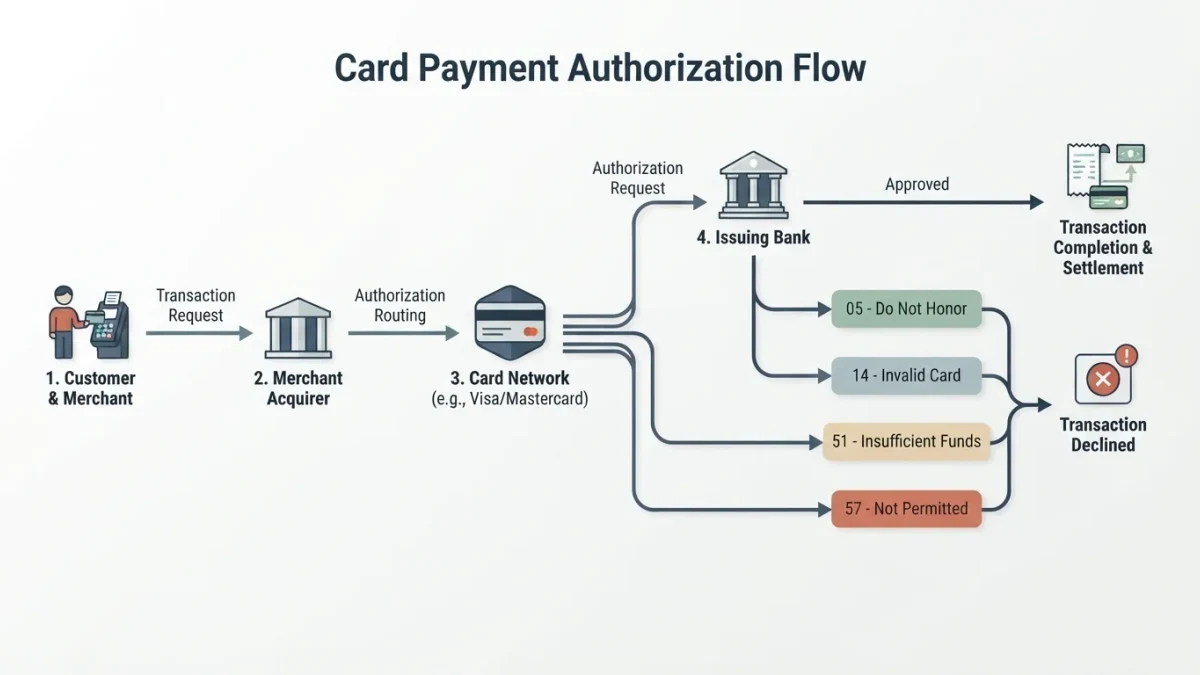

Payment failures — not cancellations — account for 29 percent of total subscription churn, and 22 percent in SaaS specifically, per Churnkey's involuntary churn benchmarks. Average card decline rates run near 13 percent on recurring charges, per Recurly data cited by GoCardless. The machinery that recovers this money is dunning: scheduled retries, card updaters and the messages that run between them.
What is dunning in a subscription business?
Dunning is the borrowed B2B term for systematically chasing an unpaid invoice. In subscriptions it means the automated sequence a business runs after a recurring charge fails: retry the card on a schedule, refresh the stored card where possible, notify the customer, and only then cancel the subscription. A dunning system is judged by recovered revenue and involuntary churn — subscriptions lost to payment failure that the customer never chose to end.
The distinction matters because involuntary churn looks identical to voluntary churn in a naive dashboard. The customer did not cancel; the charge failed, the retries exhausted, and the account closed itself. Separating the two flows is the first analytics project every subscription business eventually runs.
Why do stored cards keep failing?
Card-on-file portfolios decay on their own. Cards expire, get reissued after data breaches, are replaced when issuers rotate credentials, and change when customers switch banks — every event quietly invalidates the stored number. Issuers also decline recurring charges directly: fraud filters flag merchant descriptors customers do not recognize, and insufficient-funds logic blocks charges at the wrong moment.
The decline mix drives the recovery strategy. Expired and reissued cards answer to data fixes — account updaters and customer prompts. Insufficient funds answer to timing. Fraud-flag declines answer to descriptor cleanup and clearer customer communication. A dunning program that treats all failures the same leaves each category's recovery on the table.
What do the churn numbers actually say?
The scale is well documented. Churnkey's benchmarks put failed payments at 29 percent of all subscription churn — 22 percent in SaaS — meaning nearly a third of departing customers never decided to leave. Recurly's churn research shows an average churn rate of 3.27 percent across industries, and Recurly data cited by GoCardless puts average payment failure rates near 13 percent, ranging from 5 to 18 percent by sector and market.
Run the arithmetic on a mature subscriber base and the stakes appear: a business with 100,000 subscribers and a 13 percent monthly failure rate sees 13,000 failed charges a month before a single retry. Every point of recovery on that pool is retained revenue acquired far more cheaply than a new subscription.
How should retry timing work?
Retry logic should match failure classes. Soft declines — insufficient funds, issuer timeouts — respond to calendar spacing: attempts spread across days, weighted toward the first and fifteenth of the month when consumer accounts refill, typically three to four attempts before the sequence ends. Same-hour hammering damages authorization rates and can trip issuer fraud scoring against the merchant.
Hard declines — invalid card number, expired card — should not be retried at all until the data changes. The productive path is refreshing the credential, either through an account updater service or by asking the customer. Retrying a dead number burns fees and inflates the decline statistics that processors and issuers watch. Both patterns assume clean decline-code data flowing from the gateway into the dunning engine, which is why code-level reporting belongs inside the retention stack, not only in finance.
| Failure class | Typical codes | Recovery action |
|---|---|---|
| Soft — timing | 51 insufficient funds, 65 count limit | Spread retries across days |
| Soft — infrastructure | 91 issuer unavailable, 96 malfunction | Retry within minutes |
| Hard — credential | 14 invalid card, 54 expired | Updater service or customer update |
| Hard — policy | 57 not permitted, 62 restricted | Different card required |
The table is where dunning software earns its fee. Mapping each decline code to a recovery action — instead of treating a failed charge as one undifferentiated event — is the difference between a sequence that recovers recoverable payments and one that burns attempts on payments no retry can fix.
What do card account updater services do?
Account updaters close the stale-data problem at the source. Visa Account Updater and Mastercard's Automatic Billing Updater are network services that feed reissued and replaced card numbers back to enrolled merchants, so a subscriber who received a new card keeps paying without re-entering anything. The updater cycle runs on the networks' schedule, which is why it complements rather than replaces customer prompts.
The economics are unglamorous and favorable: updater fees price per account checked, while the recovered subscriptions carry full lifetime value. For businesses with large card-on-file portfolios, enrollment is closer to infrastructure than optimization — the alternative is rebuilding payment credentials by support email.
What does a good dunning sequence look like?
Before failure: pre-dunning notices to customers whose cards expire within the billing window, and clear statement descriptors so fraud filters find fewer false positives. During failure: retries on the schedule, an in-app banner, and two to three emails that name the problem plainly — the card was declined — and make the fix a one-tap card update, not a login scavenger hunt.
At the end of the sequence, offer a pause or a downgrade before cancellation, because a plan change retains revenue a cancellation cannot. And measure the program by involuntary churn rate and recovered revenue per failed charge, not by email open rates. Dunning is collections mechanics applied to retention, and its output is money that would otherwise silently leave.