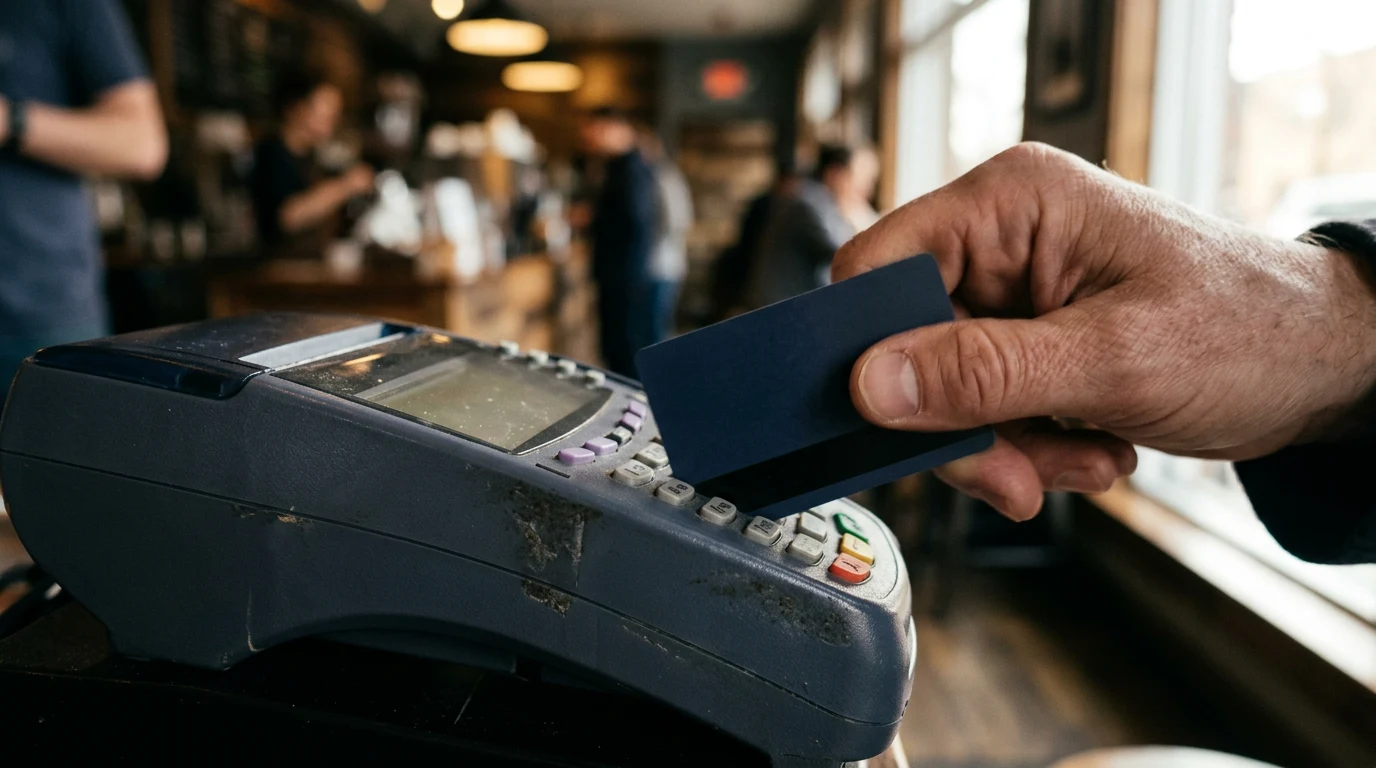
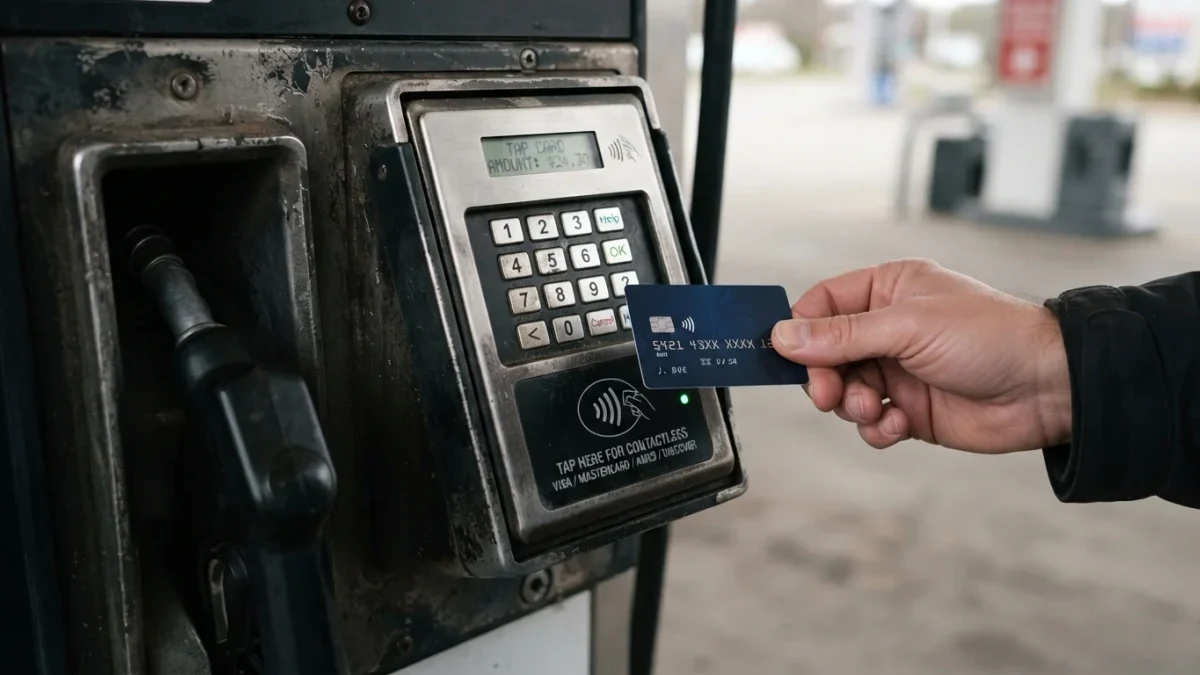
In April 2022, Visa and Mastercard raised the maximum preauthorization hold a fuel merchant can place at an automated dispenser to $175 for consumer cards, per network rule changes reported by The Wall Street Journal and Convenience Store News. That is why a $40 fill-up can freeze up to $175 of a checking account for hours after the nozzle goes back.
Why does the pump place a hold before fueling?
An automated fuel dispenser has a mechanical problem no other checkout has: it cannot know the final amount until the customer finishes. The card networks solved it with a two-step transaction. Before the pump unlocks, the merchant requests an authorization for a flat estimate — the preauthorization hold. The issuer checks the card and reserves that amount against the customer's available balance or credit line.
Nothing has been paid at that point. The hold is a claim, not a charge, and the merchant receives no money. After the customer hangs up the nozzle, the merchant submits the completion — the actual amount pumped — and the clearing process replaces the estimate with the real figure.
Why do holds run $75 to $175?
The hold size is the merchant's decision, bounded by network caps. Before 2022, caps sat low enough that surging fuel prices broke the model: a truck driver filling a large tank could pump past the authorized amount, leaving the station exposed for the difference. Visa raised its consumer preauthorization ceiling from $100 to $175 in April 2022, and Mastercard raised its consumer ceiling from $125 to $175, with its commercial card ceiling moving from $350 to $500, per the networks' 2022 rule changes.
Stations set their holds somewhere under those caps, based on their average ticket and their processor's defaults. A station near a highway with pickup traffic might hold $175 every time; a neighborhood station might hold $75. The customer sees none of this configuration — only the frozen balance.
| Network | Consumer cap before 2022 | Consumer cap since April 2022 | Commercial cards |
|---|---|---|---|
| Visa | $100 | $175 | Separate commercial limits |
| Mastercard | $125 | $175 | $500, up from $350 |
Debit changes the stakes, not the mechanics. On a credit card the hold consumes available credit; on a debit card it consumes the actual checking balance, which is how a $175 hold on a $90 account can freeze every remaining dollar and push the next real transaction into overdraft.
Why not simply authorize a small amount?
An authorization is the issuer's commitment that funds will be there when the merchant settles. If a station authorizes $1 and the customer pumps $80, the station clears $80 against a $1 guarantee. Network rules leave the merchant liable for amounts pumped beyond the authorized figure, which is exactly the exposure the hold exists to close. Estimate holds persist because the industry chose merchant protection over balance cleanliness for unattended fuel.
The same trade-off now appears wherever the final amount is unknown at tap time: hotel stays with incidentals, restaurant tabs after the tip is added, and EV chargers billing by the kilowatt-hour all run the same preauthorization-and-completion pattern, each with its own typical hold range.
How does the hold release — and why does it linger?
Release works correctly when two parties move quickly. The station's processor submits the final amount, the authorization system reconciles the difference, and the issuer drops the reserved funds back into the available balance. On credit cards the gap between the $175 hold and the $52 receipt usually closes within hours.
The hold lingers when either party is slow. Stations on smaller processors may batch completions rather than sending them in real time, and some submit the final sale without explicitly reversing the remainder, leaving the issuer to expire the hold on its own schedule. Reporting when the caps changed, The Wall Street Journal noted in June 2022 that holds can take several hours to days to fall off. Weekends extend the wait, because the completion travels with the next settlement batch.
The cardholder's bank is usually the party that can see the hold's expiry clock, which is why the first useful call after a stuck hold is to the issuer, not the station.
What does paying inside change?
Paying the cashier before fueling inverts the problem: the customer names the amount, the authorization is for that exact figure, and no estimate is needed. A $40 prepay inside authorizes $40, and the hold matches the sale. The trade is a walk to the counter and a pump that stops at the prepaid figure — a real annoyance for drivers who do not know their tank's math.
Station apps and fuel-branded wallets take the same approach with better ergonomics: the customer sets an amount or a funding amount in the app, the authorization matches it, and the hold question disappears. Some stations also configure smaller holds for PIN-debit transactions routed over debit networks, though configuration varies by merchant and processor.
What can a cardholder do about a stuck hold?
First, distinguish a hold from a charge. If the pending line shows the hold amount and no posted transaction exists, the money is reserved, not spent, and the issuer's hold-expiry policy governs when it returns. Calling the issuer confirms the clock; calling the station confirms whether the completion was sent.
Second, know what protections apply. A hold that never converts into a posted charge is not a billing error in the Regulation E sense — there is no transaction to dispute yet. The practical levers are time, the issuer's expiry window, and, at the margin, a merchant willing to send an explicit reversal. Cardholders who regularly run tight balances can sidestep the entire mechanism with a credit card at the pump or prepay inside.