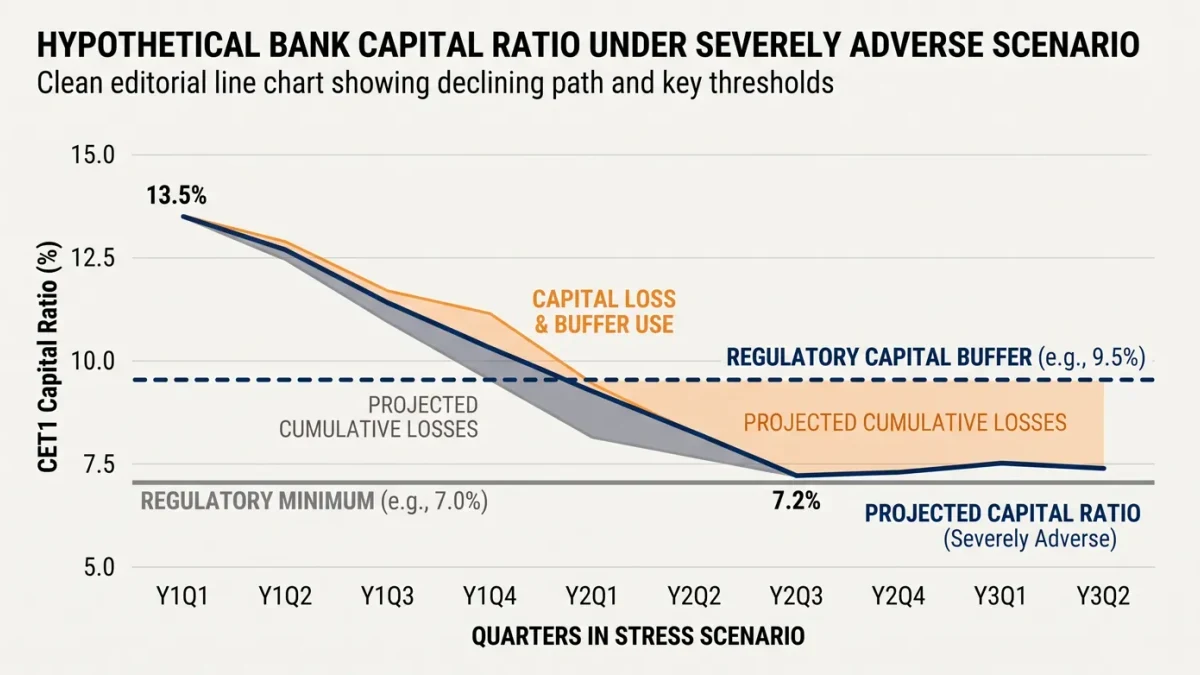

The Federal Reserve's June 2025 stress test pushed 22 banks through a hypothetical severe global recession, and their aggregate common equity tier 1 ratio fell from 13.4 percent to a minimum of 11.6 percent before recovering, per the central bank's published results. Every institution stayed above regulatory minimums — the exercise measures buffer thickness, not survival.
What Is DFAST and Who Has to Run It?
The Dodd-Frank Act Stress Test is the Federal Reserve's annual solvency drill, required by section 165(i) of the Dodd-Frank Act. Banks with 100 billion dollars or more in assets participate on a schedule set by category, and the Fed runs its own supervisory models across their balance sheets — the banks cannot grade their own homework. In the 2025 cycle, 22 banks were subject to the test, per the Fed's June 2025 results.
Smaller regional banks above 100 billion dollars in assets test in alternating years under the category framework, while the largest and most complex firms test annually. The results feed directly into each bank's capital requirements, which is why the June release moves dividend and buyback planning across the industry.
What Does the Severely Adverse Scenario Assume?
The Fed publishes its scenarios in the first quarter of each year, and the severely adverse case is a stylized disaster: the 2025 version simulated a severe global recession with substantial stress in commercial and residential real estate and corporate debt markets, per the Fed's results publication. The projection horizon runs nine quarters.
Firms with large trading operations get an additional global market shock — a hypothetical jump in asset prices and volatility applied to their trading book. The scenario is deliberately harsher than most forecasters' recession cases, because the point is to size buffers against tail losses, not to forecast the year ahead. Banks also submit their own internal scenarios under the complementary CCAR company-run requirement.
Which Capital Ratios Does the Test Measure?
The headline metric is the common equity tier 1 ratio — CET1, the highest-quality capital as a share of risk-weighted assets. The 2025 test projected the aggregate CET1 ratio of the 22 banks falling 1.8 percentage points from 13.4 percent to that 11.6 percent minimum, then recovering to 12.7 percent by the end of the horizon, per the Fed.
The test also tracks tier 1 capital, total capital, and leverage ratios against their regulatory minimums, plus projected loan losses and pre-provision net revenue by portfolio. For supervisors, the loan-level loss projections are the diagnostic: they show where the Fed's models think the credit risk actually sits — in 2025, concentrated in the commercial real estate and corporate debt assumptions built into the scenario.
How Does the Stress Capital Buffer Turn Results Into Requirements?
Since 2020, the stress capital buffer has converted test results into a binding requirement. The SCB equals a bank's projected peak-to-trough CET1 decline plus four quarters of planned common stock dividends, with a floor of 2.5 percent. A bank whose ratio is projected to fall 1.8 points under the severely adverse scenario, with a typical payout, lands near the floor.
The buffer takes effect on October 1 following each June release. A bank's total CET1 requirement becomes the 4.5 percent Basel III minimum, plus its SCB, plus its G-SIB surcharge if it is one of the global systemically important banks. Breaching the buffer does not mean failure; it means automatic restrictions on dividends and discretionary distributions until the ratio recovers.
What Happens if a Bank Breaches Its Buffer?
A buffer breach is a graduated constraint, not a seizure. Once a bank's CET1 ratio falls into the buffer range, automatic payout limits kick in: dividends and share repurchases face percentage caps tied to how far the ratio has dropped into the buffer, and the bank must submit a capital plan to restore the ratio. Management, not the regulator, chooses the mix of retained earnings and balance-sheet shrinkage.
This design keeps capital in the system during stress. In a real downturn, banks that stay above minimums but inside their buffers can keep lending while payouts shrink automatically — the lesson regulators drew from 2008-2009, when banks that passed static capital tests still cut credit to preserve ratios. The stress test asks the question in June; the buffer enforces the answer for the following four quarters.
What Changed Going Into the 2026 Cycle?
In April 2025, the Federal Reserve proposed two structural changes: averaging each bank's results over two consecutive years to smooth year-to-year volatility, and reducing the volatility of the scenario design itself, alongside expanded disclosure of model details, per the Fed's proposal. The Fed signaled the changes were intended to take effect for the 2026 cycle.
The proposal followed years of industry complaints that single-year scenario swings produced unpredictable capital requirements. Whatever the final calibration, the architecture the test rests on — supervisory models, a nine-quarter horizon, a CET1 decline translated into a live buffer requirement — remains the mechanism regulators watch first when they ask whether a bank can lend through a recession.
Why Do Markets Watch the June Release?
The release is a capital-planning event. Boards set payout policy against the buffer that the results imply, and a smaller projected drawdown directly frees capacity for dividends and repurchases in the following year. In 2025, the aggregate drawdown of 1.8 percentage points was smaller than prior years, per the Fed, which is why the release read as headroom.
For professionals, the operational readout is threefold: the aggregate cushion, each institution's distance from its buffer, and the loss assumptions the Fed's models embedded by portfolio. Those three numbers, refreshed every June, are the public system's closest thing to a standing answer on whether the largest banks can absorb a severe recession without cutting lending.