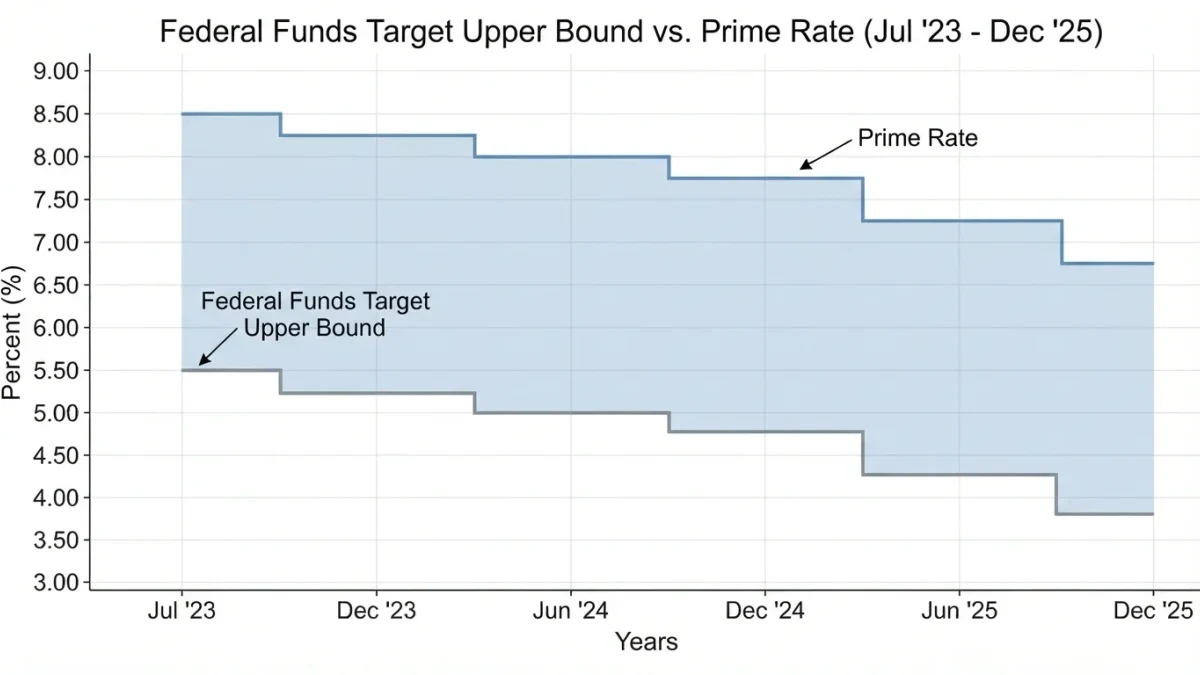

Most U.S. credit card accounts carry a variable APR calculated as the prime rate plus a margin, and the prime rate has stood at 6.75% since the Federal Reserve's December 10, 2025 cut, through holds on January 28 and March 18, 2026 (Federal Reserve, 2026). Average card rates nonetheless held above 22% on accounts assessed interest through 2025 (Federal Reserve G.19 consumer credit release, 2025). The formula moves fast; the margin does not.
Nuv Media publishes information, not financial advice.
How Is a Variable Card APR Built?
Two components: an index, almost always the prime rate, and a contract margin fixed when the account is opened. Prime itself is a convention, not an administered rate - major banks quote it at the top of the fed funds target range plus three percentage points, so the current 3.50%-3.75% range maps to 6.75% (Federal Reserve, December 2025). A card priced at prime + 14.74 pays 21.49% today and reprices the day the index moves.
The repricing is automatic and contractual. When the Fed changes the target range and banks reset prime, every account tied to that index changes at the next billing cycle, with no action by the issuer or the cardholder. That is why the card market is the fastest-transmitting consumer credit market in the U.S. system - in the downward direction as well as the upward one.
What Does the CARD Act Require When Rates Move?
The Credit CARD Act of 2009 draws a sharp line between rate changes an issuer chooses and rate changes an index causes. Issuer-initiated increases on existing balances are restricted: they generally require 45 days' advance notice, apply only to purchases made after the notice period, and cannot be applied retroactively to the existing balance except in narrow cases such as serious delinquency (Regulation Z, 12 CFR 1026.9 and 1026.55).
Index-driven changes are exempt from that machinery. Because the issuer is not choosing to raise the rate - the prime rate moved - a variable APR can change with no 45-day notice and the new rate applies to outstanding balances. Every other CARD Act protection still holds; the exemption is about the trigger, not about disclosure rules in general.
When notice is required, it is specific: the disclosure must state the new rate, when it takes effect, and the cardholder's right to reject the change, which generally closes the account to new purchases while the balance is repaid under the old terms (Regulation Z, 12 CFR 1026.9(c)). Issuers deliver these notices with the monthly statement, which is why the 45 days function as roughly one and a half billing cycles in practice.
One more provision matters for pricing desks: the reevaluation rule. After an issuer raises a rate for risk or other account reasons, it must review the account at least every six months and reapply the lower rate if the basis for the increase has receded (Regulation Z, 12 CFR 1026.55(f) framework). Again, this governs issuer-chosen increases - index movements are outside its scope.
Why Did Average APRs Stay High While the Fed Cut?
Because the margin, the second half of the formula, is set for loss experience - and it repriced upward after 2022. Average APRs on accounts assessed interest were about 22.8% in 2023 (CFPB Consumer Credit Card Market Report, 2023) and commercial-bank card rates held above 22% through 2025 even as the policy rate fell by a full percentage point from its peak (Federal Reserve G.19, 2025).
The margin embeds charge-off and delinquency assumptions, funding costs and the competitive intensity of the card market. Those ingredients move slowly, and issuers adjust margins mostly at origination for new accounts, not retroactively across the book. Result: the index leg transmits Fed cuts within weeks while the margin leg barely moves, leaving average APRs near record highs relative to the policy rate.
The CFPB's market reports have documented the same arithmetic: the spread of card APRs over prime widened to multi-decade highs by 2023, as penalty and risk-based pricing built into the book after the pandemic-era loss cycle (CFPB, 2023). A falling policy rate narrows the index side of the ratio only.
How Fast Do Card APRs Actually Fall After a Cut?
For a standard variable account, within one billing cycle of the prime rate change - faster than any deposit product and without any notice mechanics, because the CARD Act's 45-day requirement does not apply to index movements. In the current cycle, the three 2025 cuts each lowered prime by a quarter point, and card APRs tied to prime fell by exactly that margin, no more (Federal Reserve, 2025).
What does not fall is the account's spread. A card at prime + 14.74 in December 2025 is at prime + 14.74 in March 2026; only the prime leg changed, and only if the Fed actually moved - the January and March 2026 meetings both held the range at 3.50%-3.75% (Federal Reserve, 2026). Fixed-rate promotional offers behave differently again: their teaser periods run to a contract date, after which the account typically rolls to the standard variable formula.
What Should Payments and Issuing Professionals Watch?
Three things, all mechanical. First, the FOMC calendar - prime changes only when the target range does, so meeting outcomes are the schedule for repricing. Second, the Federal Reserve's G.19 release for the aggregates: it tracks average card rates on all accounts and on accounts assessed interest, which separates revolving behavior from headline pricing (Federal Reserve G.19, monthly).
Third, margin indicators: the CFPB's biennial card market reports and issuer 10-Qs disclose loss assumptions and yield metrics that explain why the spread over prime sits where it does. Between those three series, the entire card APR - index, margin and behavior - is observable without any prediction about the Fed's next decision, which this article does not make.