Google announced the Agent Payments Protocol in May 2025, backed by more than 60 payments and technology companies, and OpenAI and Stripe released the rival Agentic Commerce Protocol in September 2025 (Google, 2025; OpenAI and Stripe, 2025). Both exist to answer one question: how could an AI agent pay a merchant on a customer's behalf without becoming a fraud liability.
Nuv Media publishes information, not financial advice. Stablecoin rails are volatile and losses are possible. This explainer describes capabilities in would-and-could terms and reports only verifiable launches and announcements through August 10, 2026.
How would an AI agent pay on a customer's behalf?
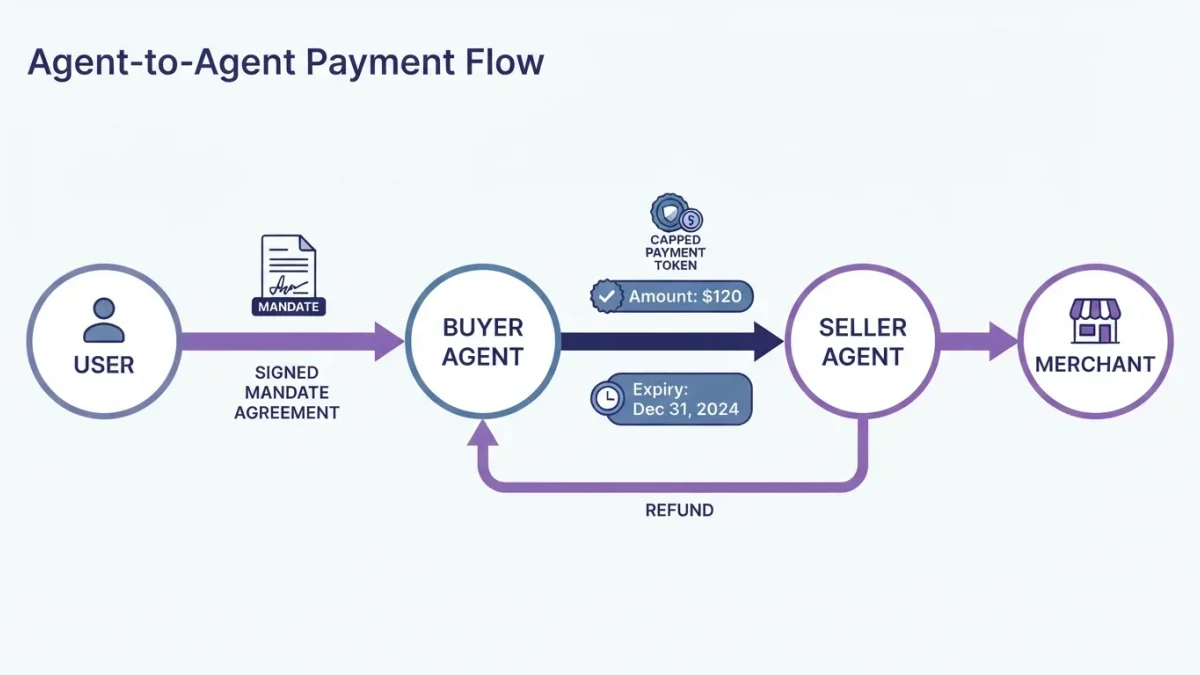
The recurring design across the 2025-2026 protocols is a mandate plus a constrained token. The customer would sign a mandate — a machine-readable authorization object stating who may buy what, up to which amount, until when. When the agent finds the item, it would present that mandate and receive or use a scoped payment token: a credential limited to one merchant, one amount and a short window, similar in spirit to the network tokens wallets use, but capped and expiring by design.
AP2, the protocol Google announced at its developer conference in May 2025 and built with partners including Adyen, American Express, Mastercard, PayPal, Coinbase, Revolut and Worldpay, formalizes this as cryptographically signed mandate objects in three forms — intent, cart and payment — exchanged between buyer and seller agents (Google, 2025). The payment method itself is abstract: card, bank transfer or stablecoin could settle underneath.
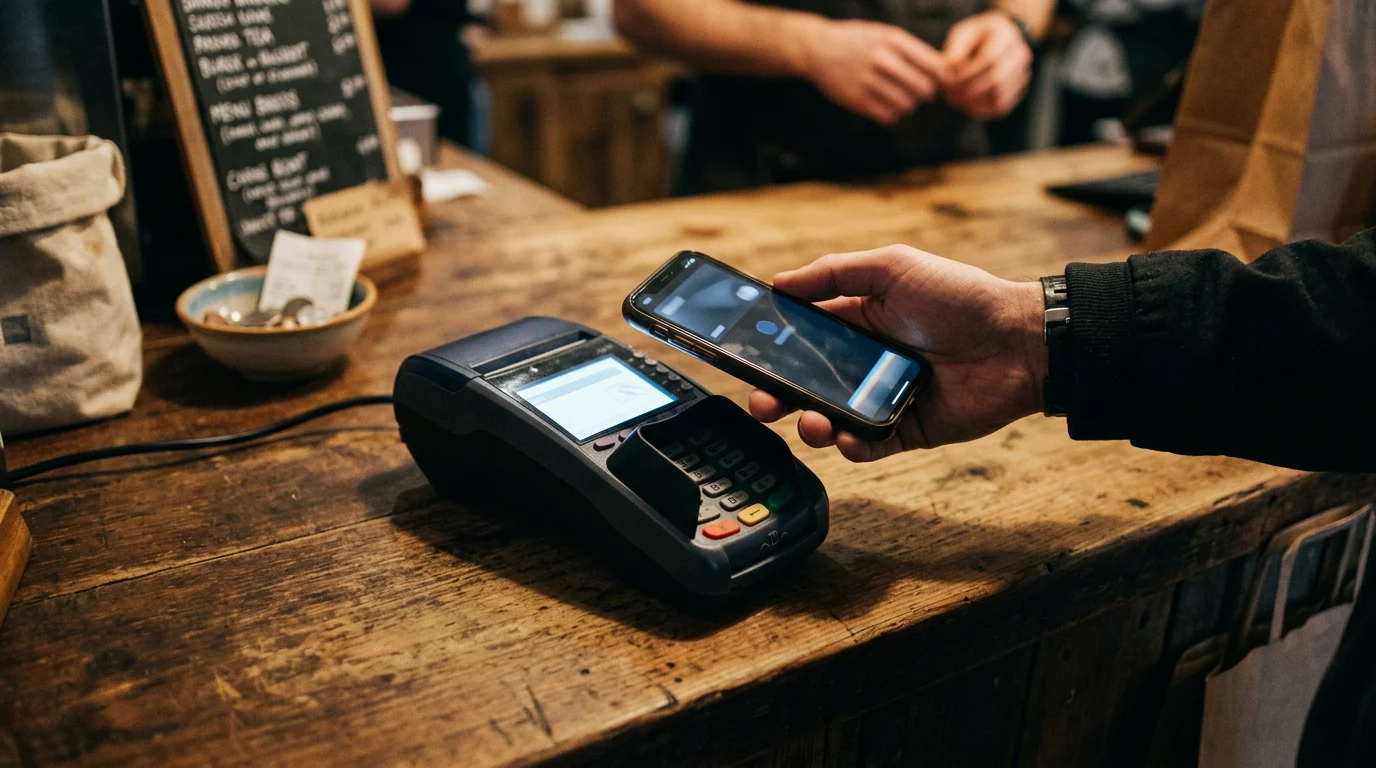
The key property is that the agent would never hold the underlying credential. Just as a phone wallet pays with a device token rather than the printed card number, an agent would transact with a token whose scope, amount ceiling and expiry the customer or issuer controls — and which can be revoked without reissuing anything.
What standards and pilots actually shipped?
Four dated efforts anchor the field. Coinbase open-sourced x402 in May 2025, a protocol that repurposes the HTTP 402 status code for machine-to-machine stablecoin payments (Coinbase, 2025). Google's AP2 followed the same month (Google, 2025). In September 2025, OpenAI and Stripe released the Agentic Commerce Protocol under an open-source license, built around four checkout endpoints and single-use, amount-limited payment tokens (OpenAI and Stripe, 2025). In March 2026 Stripe and Tempo launched the Machine Payments Protocol with a session-based model spanning stablecoins and fiat, card support from Visa, and more than 100 services integrated at launch (Stripe and Tempo, 2026).
Deployments followed. OpenAI's Instant Checkout, built on ACP, began letting ChatGPT users buy from U.S. Etsy sellers in February 2026, though OpenAI scaled back in-chat purchasing in March 2026 toward an app-based model (OpenAI, 2026). Stripe added x402 support for USDC payments on the Base network in February 2026, and Coinbase and Cloudflare had co-founded the x402 Foundation in September 2025 to govern the spec (Stripe, 2026; x402 Foundation, 2025). The card networks announced their own pieces in 2025 — Mastercard's Agent Pay agentic tokens and Visa's agentic commerce APIs — as company announcements rather than general-availability services (Mastercard, 2025; Visa, 2025).
How would a merchant know the agent is authorized?
Identity proofs would carry the answer. A seller-side agent receiving a payment request would verify the signed mandate — checking the signature, the amount ceiling, the expiry and the binding to the buyer's identity — before releasing goods. AP2 mandates are signed with elliptic-curve keys, so the verification is cryptographic rather than reputational (Google, 2025). ACP reaches the same end through its checkout endpoints: the merchant validates the session and the single-use token rather than trusting an agent's self-description (OpenAI and Stripe, 2025).
What is unresolved is the identity layer above the signatures: who vouches that a given agent belongs to the person it claims, and where revocation lists live. Current deployments sidestep the problem by keeping the human in the loop for high-value confirmation — the ChatGPT checkout experience shows the user the cart before purchase — which works for retail prices but would not scale to an agent placing hundreds of orders.
What are the limits and dispute problems?
Every protocol answers overcharge risk with caps: single-use tokens in ACP, amount-scoped mandates in AP2, session spending limits in MPP. A compromised agent could spend up to its mandate and no further. The harder question is what happens after a bad purchase. Card-funded agent payments would inherit the card networks' chargeback machinery, so the human could dispute as today. Stablecoin-funded payments through x402 settle finally on-chain, with no chargeback analog — merchant and buyer would depend on protocol-level refund flows and, failing those, on whatever recourse the counterparty offers voluntarily.
Consumer-protection mapping is genuinely open. If a customer authorized an agent broadly and the agent bought the wrong thing, is that an unauthorized transaction under Regulation E, or an authorized purchase the customer regrets? No U.S. regulator had issued agent-payment guidance as of August 2026, and the protocols' answer — keep mandates narrow, keep the human confirming — is a design convention, not a legal one.
What is live versus what remains a proposal?
Live as of August 2026: ChatGPT's app-based shopping with U.S. Etsy sellers, x402-based stablecoin payments on Base, and MPP's session-based integrations. In pilot or announced-only: the card networks' agentic tokens and the full AP2 mandate ecosystem, which remains a specification with named supporters rather than a broadly reachable network. The checkout endpoint pattern — ACP's four calls — is the closest thing to a deployed standard, and even it reached customers through one platform's app.
For payments professionals, the planning posture is concrete: agents could transact under signed, capped mandates today on narrow rails, and the open questions are identity, dispute mapping and cross-protocol reach — not the basic mechanics of delegated payment.