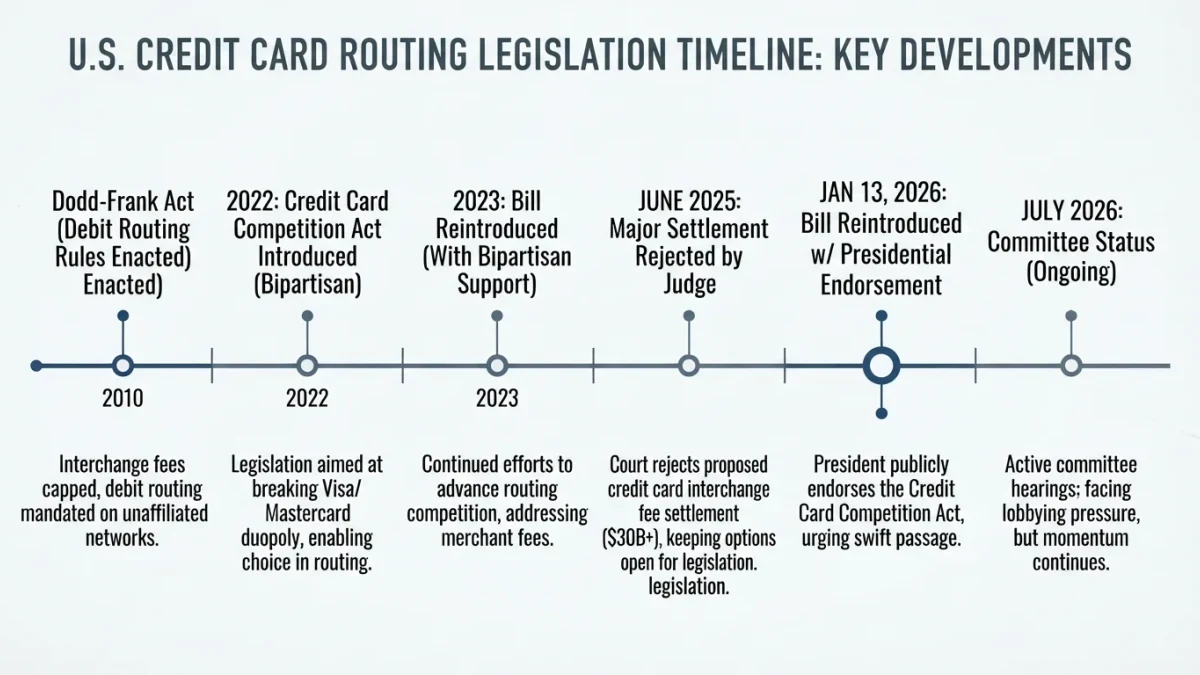
The Credit Card Competition Act of 2026 was introduced in the Senate on January 13, 2026, and referred to the Banking, Housing, and Urban Affairs Committee, per Congress.gov. The bill would require the largest card-issuing banks to enable a second payment network for credit card routing — and this time it arrived with public endorsement from President Trump, who criticized swipe fees in mid-January, per Consumer Finance Monitor.
Nuv Media publishes information, not financial advice.
What would the 2026 bill require?
The bill, S. 3623, amends the Electronic Fund Transfer Act and directs the Federal Reserve to write regulations on credit transaction routing. Its core mechanism: banks with more than $100 billion in assets must enable at least one additional payment network on the credit cards they issue — a network unaffiliated with the two largest networks, Visa and Mastercard — so merchants can route credit transactions over a cheaper rail, per the bill's text and summaries.
The design copies the debit model Congress built in 2010. The Durbin Amendment and the Federal Reserve's Regulation II already require two unaffiliated networks on debit cards; the 2026 bill extends the same architecture to credit, where routing today runs exclusively over the network branded on the card.
Where does the bill stand as of July 2026?
In committee, without a markup. Congress.gov shows S. 3623 at the introduced stage before the Senate Banking Committee, with a companion House bill filed alongside it, and no floor vote scheduled. Earlier versions of the legislation, first introduced in 2022 and reintroduced in 2023, never reached a Senate vote despite Judiciary Committee hearings.
The difference in 2026 is political cover. Presidential endorsement of swipe-fee criticism moved the bill from a retailer cause to a live negotiating item, per Consumer Finance Monitor's January 16, 2026 report — though a statement of support is not a scheduled vote, and the banking committee has not acted.
Who supports and opposes routing mandates?
The split has not moved since the bill first appeared. Retail groups, led by the National Retail Federation, argue merchants pay too much in interchange and would route to cheaper networks given the choice. Banks, card networks, and their associations argue the mandate is price control by another name — warning that routing away from premium networks would strip the interchange revenue that funds rewards programs and fraud protection.
Both sides are arguing about the same money. Interchange on credit transactions is paid by merchants' banks to issuers, recovered in merchant pricing, and partially returned to cardholders as rewards. Any routing rule that cuts the average fee redistributes that pool rather than shrinking it — the debate is over which end of the chain keeps it.
Why the settlement route collapsed first
The legislative push also inherits momentum from the courtroom. In June 2025, a federal judge in Brooklyn rejected the proposed settlement in the long-running merchant class action over Visa and Mastercard interchange — a deal estimated at roughly $30 billion in swipe-fee concessions over five years — leaving merchants without a negotiated remedy and returning the fight to Congress, per the court's order and contemporaneous reporting.
For payment teams, the practical reading: nothing in the routing stack changes while S. 3623 sits in committee. But the bill's mechanics are specific enough — issuer-side network enablement, merchant-side routing choice, Federal Reserve rulemaking — that acquirers and gateways are already mapping what dual-network credit routing would demand of their platforms if 2026 becomes the year a version finally moves.