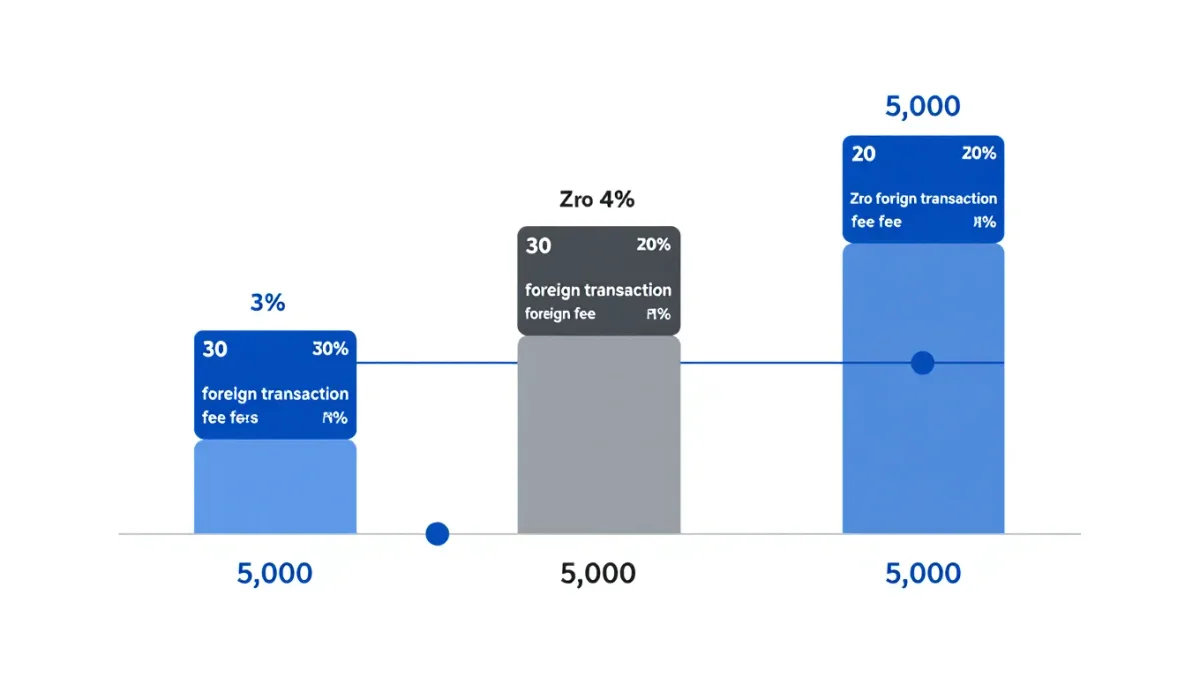
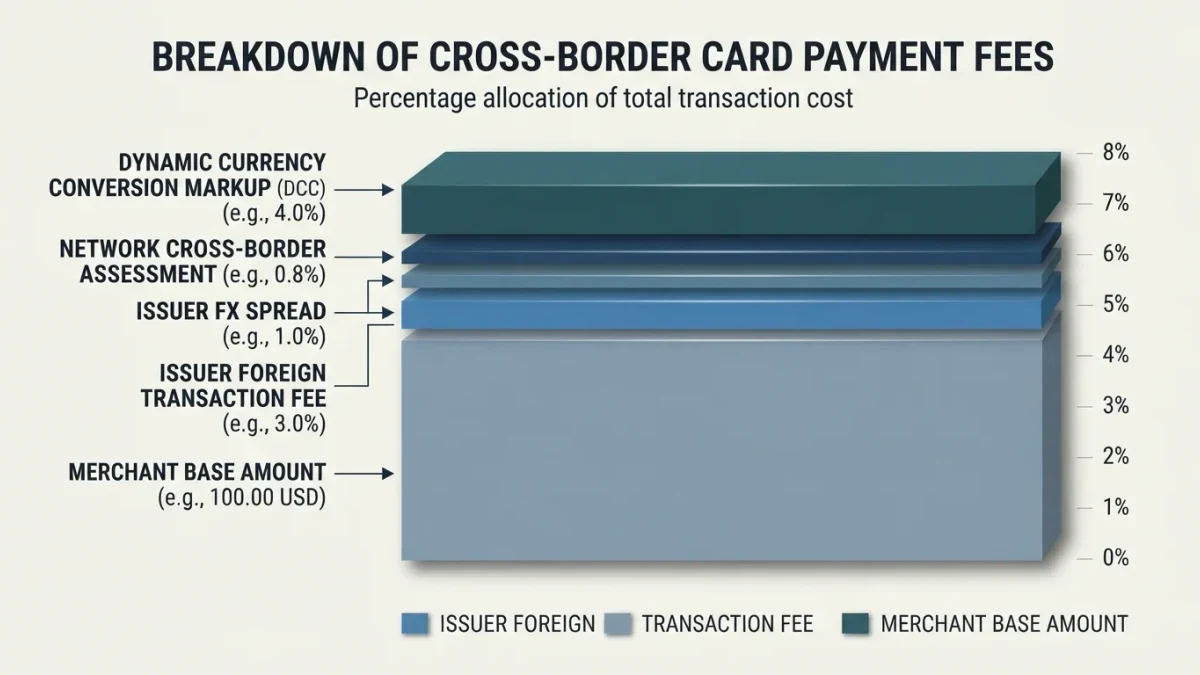
Paying in your home currency at a foreign checkout adds between 2 and 5 percent to in-store card purchases, the European consumer organization BEUC found in its 2017 analysis of dynamic currency conversion. That markup is only the most visible layer. Cross-border payments carry a stack of fees — issuer spread, network assessment, processor margin — and most of them never print on a receipt.
Nuv Media publishes information, not financial advice.
How many fee layers does a cross-border card payment carry?
At least three, sometimes four. Each layer belongs to a different party, and each is disclosed in a different place — or nowhere the cardholder looks. The table below is the anatomy of a payment made with a US-issued card at a merchant in another currency zone.
| Layer | Who charges it | Where it hides |
|---|---|---|
| Foreign transaction fee | Issuing bank | Card fee schedule, billed later |
| FX spread over the network rate | Issuing bank | Buried in the posted exchange rate |
| Cross-border assessment | Card network | Passed to the merchant or its processor |
| DCC markup | Merchant's conversion provider | Shown as a convenience at checkout |
The practical point: the merchant absorbs some layers into its pricing, the issuer bills others to the cardholder, and one — dynamic currency conversion — is offered to the customer as a choice. Understanding who owns each layer explains why the same purchase costs different amounts depending on which button the cardholder presses.
Where does the issuer's FX spread sit?
When a card transaction crosses currencies, the conversion runs over the network's rate — Visa and Mastercard each publish the wholesale reference rates they use for settlement. The issuer converts at that rate and applies its own economics on top: a foreign transaction fee stated in the card's terms, plus any pricing built into how the issuer rounds the rate.
Foreign transaction fees are the layer consumers can actually control, because they are printed in pricing sheets and vary widely between card products. The spread itself is quieter: two cards can post noticeably different amounts for the same purchase on the same day, and the difference sits in each issuer's conversion practice.
What do the networks charge?
Visa and Mastercard levy cross-border assessments — surcharges on transactions where the merchant's country differs from the cardholder's country. These fees sit on the acquiring side: the network bills the merchant's processor, and the cost flows into merchant pricing or into explicit international service fees on the cardholder's statement depending on how the issuer and the merchant pass costs through.
For merchants selling internationally, assessments are part of the cost of acceptance that varies by corridor, alongside interchange differences by country. That variance is one reason large merchants weigh local acquiring — establishing processing entities in major markets so transactions clear domestically — against the overhead of maintaining them.
Why does dynamic currency conversion cost more?
Dynamic currency conversion is the checkout-screen offer to pay in your home currency instead of the merchant's. When the customer accepts, conversion runs through the merchant's DCC provider rather than the card network, and the provider's margin replaces the issuer's normal conversion path. The merchant and the DCC operator typically share the revenue that margin generates — which is why the offer is presented so persistently.
BEUC's 2017 position paper documented additional costs between 2 and 5 percent for in-store payments, and card scheme data have consistently shown DCC rates worse than scheme rates. The European Union responded with Regulation 2019/518, phased in by April 19, 2020, which requires merchants offering DCC in the EU to disclose the currency conversion charge and the total cost as a percentage, making the markup visible at the point of choice.
The counter-strategy is one sentence: pay in the local currency. Declining DCC routes conversion through the network rate and the issuer's fee schedule — usually the cheaper path for the cardholder.
How do wires hide their costs?
Corporate and individual wire transfers hide markup in two places: the FX spread charged by the executing bank and the correspondent chain. On a traditional SWIFT wire, the payment can pass through multiple correspondent banks, each entitled to deduct its fee en route — which is why the received amount can fall short by amounts neither sender nor recipient agreed to.
The instruction code determines who absorbs what. OUR means the sender pays all fees, SHA splits them, and BEN deducts everything from the recipient. None of these codes touches the FX spread, which is set by whichever bank executes the conversion. Fintech transfer services compete precisely on this spread and on providing it up front, which is why comparing the delivered amount — not the advertised fee — is the only reliable test.
What does disclosure actually require?
In the United States, Regulation E for debit accounts and Regulation Z for credit accounts require that the fee for foreign transactions be disclosed in the account's terms before it is charged — the fee schedule is the disclosure. What the rules do not require is any statement of the FX spread itself; the posted amount simply reflects the issuer's conversion.
DCC is the one layer with point-of-sale disclosure duties in both regimes. Network rules require the cardholder to be offered a genuine choice of currency with the conversion shown before the sale, and EU rules add the percentage-cost disclosure. In practice, enforcement is uneven, and the lowest-friction protection remains behavioral: choose local currency, know the card's foreign transaction fee before traveling, and compare delivered amounts — not headline fees — when sending wires.