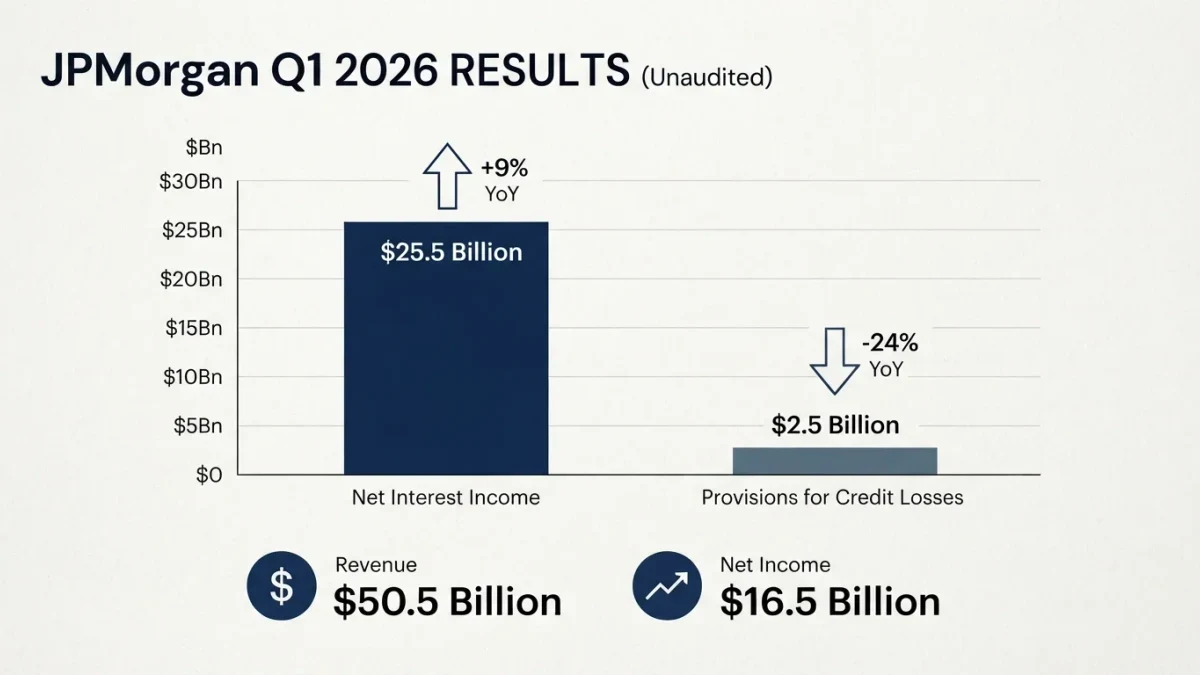
JPMorgan Chase opened the Q1 2026 bank reporting season on April 14, 2026 with net income of $16.5 billion, up 13% year over year, on managed revenue of $50.5 billion, up 10% (JPMorgan earnings release, April 14, 2026). Net interest income rose 9% to $25.5 billion, while the provision for credit losses fell 24% to $2.5 billion. Diluted EPS of $5.94 beat the roughly $5.45 analysts expected (per CNBC, April 14, 2026).
Nuv Media publishes information, not financial advice.
What Did JPMorgan Report for Q1 2026?
The headline set: net income $16.5 billion (+13% y/y), diluted EPS $5.94 (+17%), managed revenue $50.5 billion (+10%), return on tangible common equity 23% (JPMorgan earnings release, April 14, 2026). The quarter combined higher balances, a lighter credit bill and strong markets and payments revenue - the release cites J.P. Morgan Payments revenue of $5.1 billion, up 12% year over year.
CET1 capital stood at $291 billion. The bank reported the quarter with the policy rate at 3.50%-3.75%, the range the Federal Reserve has held since December 2025 (Federal Reserve, 2026), which is the backdrop against which every balance-sheet line below should be read.
What Drove Net Interest Income?
Total NII reached $25.5 billion, up 9% year over year. The cleaner read is the ex-Markets figure: $23.3 billion, up only 3%, which the release attributes to higher deposit balances and Card revolving balances "predominantly offset by the impact of lower rates" (JPMorgan earnings release, April 14, 2026).
That one sentence is the entire net interest margin story of the cycle in miniature. Volume is growing - deposits and revolving card balances - while the rate earned on those balances compresses with a policy rate a full 1.75 points below its 2023 peak of 5.25%-5.50% (Federal Reserve, 2025). NIM, the ratio of NII to earning assets, is being pulled from both directions at once; NII dollars still rose because the denominator grew.
What Did Deposits and Loans Do?
Average deposits rose 7% year over year and 1% quarter over quarter; average loans rose 11% year over year and 2% quarter over quarter, reaching roughly $1.5 trillion firmwide (JPMorgan earnings release, April 14, 2026). Loan growth outrunning deposit growth is the configuration that keeps funding valuable even as rates fall.
For deposit-market watchers, the 7% figure shows balances still compounding at the largest U.S. retail bank after two years of money market fund competition. The pricing side - what those deposits cost - is exactly where falling policy rates bite, which is why the ex-Markets NII line grew only 3% against double-digit balance growth.
What Happened With Credit Reserves?
The provision for credit losses was $2.5 billion, down 24% year over year: $2.3 billion of net charge-offs plus a net reserve build of $191 million (JPMorgan earnings release, April 14, 2026). Inside the build, wholesale reserves increased $327 million while consumer reserves released $139 million - a split that tilts the caution toward commercial borrowers.
A shrinking provision alongside an 11% loan book is the benign combination: charge-offs absorbed within earnings, reserves still edging up where the bank sees risk. One bank's quarter is one data point, but it is the data point the season's other large lenders will be measured against.
What About the Full-Year NII Outlook?
Per CNBC's April 14, 2026 coverage, JPMorgan lowered its full-year 2026 net interest income guidance to about $103 billion. Guidance is a company disclosure about its own book, not a market forecast - and this article adds none of its own.
What the Q1 2026 numbers document is a bank still growing interest revenue on volume, absorbing lower rates on margin, holding credit costs down, and telling investors to expect the rate effect to keep weighing. The rest of the season fills in whether that pattern is JPMorgan-specific or systemic.