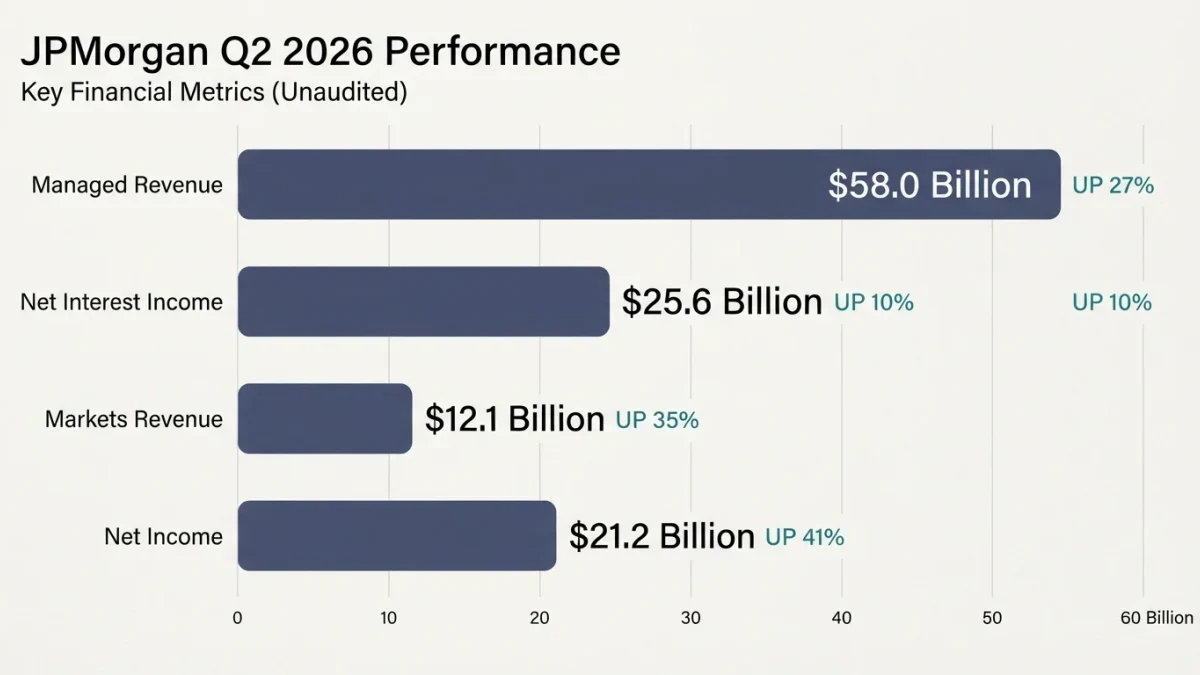
JPMorgan Chase reported the largest quarterly profit ever posted by a U.S. bank on July 14, 2026: net income of $21.2 billion, up 41% year over year, on managed revenue of $58.0 billion, up 27% (JPMorgan earnings release, July 14, 2026). Net interest income rose 10% to $25.6 billion and Markets revenue rose 35% to $12.1 billion. The quarter included $4.2 billion of after-tax significant items.
Nuv Media publishes information, not financial advice.
What Did the Season Deliver at the Largest Bank?
The headline record deserves its asterisk up front. Stripping out significant items - a $4.6 billion net gain on Visa shares and $1.0 billion of gains on certain equity investments, $4.2 billion after tax - net income was $16.9 billion, up 13%, and diluted EPS $6.14 rather than the reported $7.70 (JPMorgan, July 14, 2026). Return on tangible common equity was 29% reported, 23% excluding items.
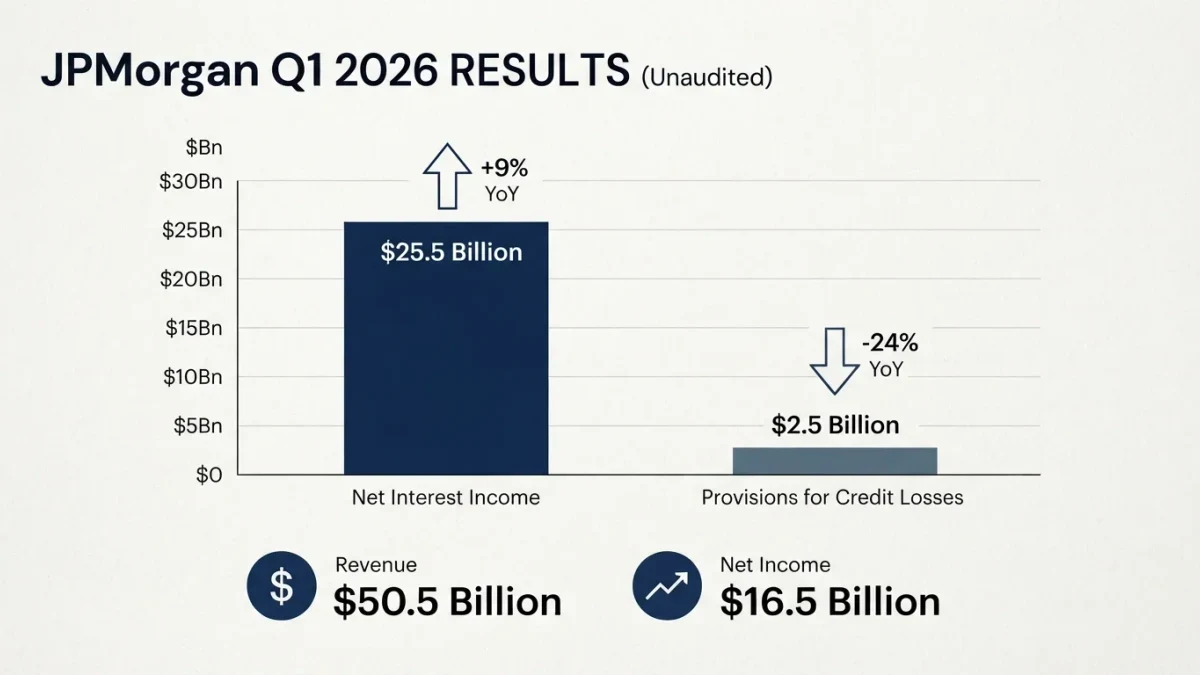
Even the clean number shows a bank compounding: the ex-items quarter sits on top of a Q1 2026 in which net income was $16.5 billion with 23% ROTCE (JPMorgan, April 14, 2026). The season's first mega-report thus delivered both a record and a readable underlying trend.
What Happened With Net Interest Income?
Total NII reached $25.6 billion, up 10% year over year; excluding Markets, NII was $23.7 billion, up 4% (JPMorgan, July 14, 2026). The volume side did the work again: average loans rose 10% year over year and 2% sequentially, average deposits rose 7% and 3% - all against a policy rate the Federal Reserve has held at 3.50%-3.75% since December 2025 (Federal Reserve, 2026).
The guidance line reversed course. In April the bank had trimmed its 2026 NII outlook to about $103 billion (per CNBC, April 14, 2026); with Q2 it raised that outlook to roughly $105.5 billion (per Yahoo Finance, July 14, 2026). Company guidance is the bank's own disclosure, and this article adds no independent projection of its own.
What Did Trading Revenue Do?
Markets revenue of $12.1 billion rose 35% year over year, with Equity Markets at $6.0 billion, up 86%, and Fixed Income Markets at $6.1 billion, up 6% (JPMorgan, July 14, 2026). Part of the equities surge connects to the same significant items that lifted the bottom line.
The macro backdrop for the trading desks was documented across the quarter: an energy price shock that drove a 21.2% one-month gasoline spike in March CPI and a 5.7% energy reversal by June (BLS, 2026), a 10-year Treasury yield that swung from 4.30% to a 4.48% peak and back within July (U.S. Treasury, 2026), and Middle East conflict uncertainty named in FOMC statements (Federal Reserve, June 17, 2026). Volatility of that kind is revenue for a markets franchise.
What Did Credit Reserves Show?
The provision for credit losses was $2.5 billion, against $2.8 billion a year earlier: $2.4 billion of net charge-offs - down $44 million - plus a net reserve build of $149 million, primarily in wholesale portfolios (JPMorgan, July 14, 2026). The prior-year quarter had carried a $439 million build.
Read against Q1's $2.5 billion provision and $191 million build, the reserve picture across the first half of 2026 is one of stability: charge-offs flat, builds modest, and the incremental caution still directed at commercial books rather than consumers (JPMorgan, 2026). J.P. Morgan Payments, the unit most relevant to this publication's readers, posted record revenue of $5.3 billion, up 12% year over year.
What Is the Season Read?
Three verifiable takeaways from the season's pacesetting report. Interest revenue is still growing on volume - NII up 10% with the policy rate frozen all year. Markets delivered the quarter's upside, helped by an equity stake gain that also flatters the headline. And credit costs stayed contained, with wholesale books absorbing the marginal reserve dollars.
This wrap anchors on the largest bank's verified release; peers reported through the same mid-July window. It reports what was published, makes no call on second-half NII, credit or markets, and offers no view on any bank's shares.